

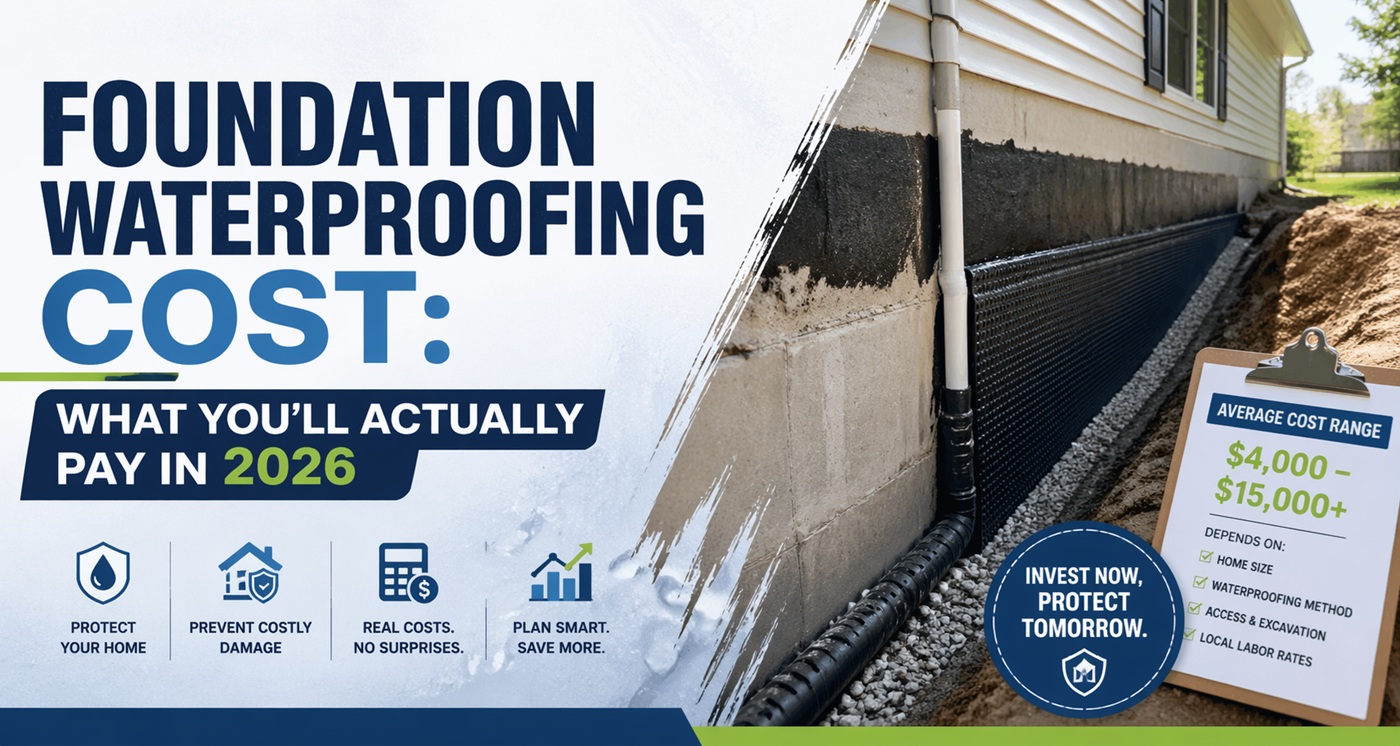
Foundation waterproofing cost depends entirely on which of four very different jobs you’re actually buying. A minor interior sealant treatment runs $500 to $2,000. An interior drainage system with a sump pump runs $3,000 to $8,000. Exterior waterproofing with membrane application runs $8,000 to $15,000. Full exterior excavation with new drain tile pushes $15,000 to $30,000 or more.
When you see “average foundation waterproofing cost is $5,000” in one article and “$13,000” in another, both are technically accurate — they’re just pricing different scopes of work. This guide breaks down what each scope actually includes, how to tell which one your foundation needs, and how to compare quotes when contractors are measuring differently.
Foundation waterproofing and basement waterproofing are used interchangeably by most contractors and search engines, so the ranges below apply whether the quote is labeled one way or the other.
The four jobs hiding behind “Foundation waterproofing”
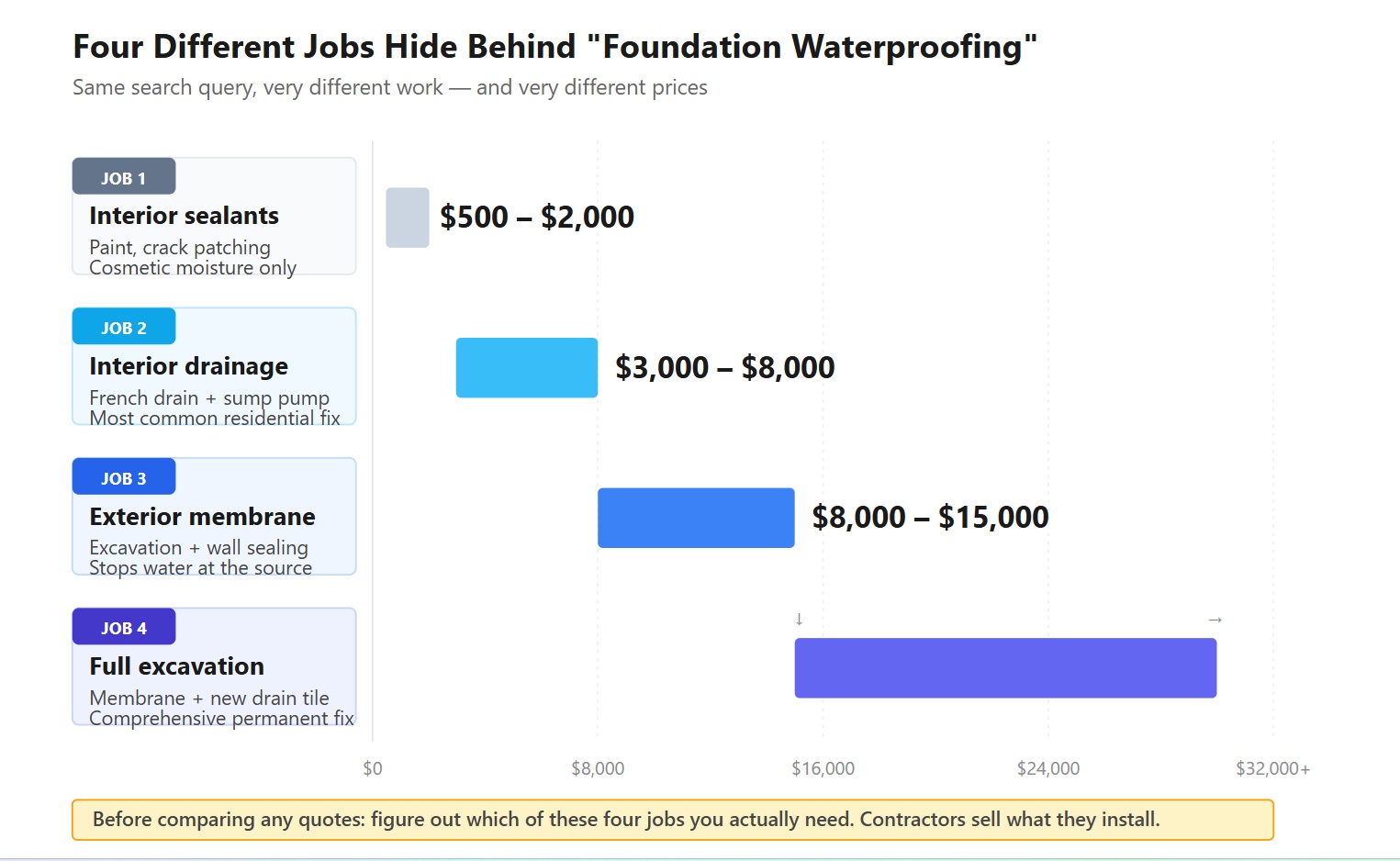
Before looking at any quote, decide which of these four conversations you’re actually in.
Job 1: Interior sealants and minor crack repair — $500 to $2,000. Waterproof paint on basement walls, epoxy injection on hairline cracks, maybe some hydraulic cement patching around pipe penetrations. This is cosmetic moisture management, not real waterproofing. Works for minor dampness and condensation. Does not work for active water intrusion or hydrostatic pressure. If a contractor quotes you $900 for “waterproofing” and hands you a paintbrush, this is what they mean.
Job 2: Interior drainage system — $3,000 to $8,000. A French drain channel cut into the basement floor perimeter, routed to a sump pump that discharges outside. This doesn’t stop water from entering the foundation — it catches the water once it’s inside and pumps it out. It’s the standard fix for most residential basement water problems because it works without excavation and addresses real hydrostatic pressure issues. Most “basement waterproofing” companies advertising to homeowners are selling this.
Job 3: Exterior waterproofing membrane — $8,000 to $15,000. Excavation down to the footing around the problem walls, pressure-washing the foundation, then applying a liquid or sheet membrane to seal the exterior. This is true waterproofing — it stops water at the foundation wall rather than managing it after entry. The price range reflects whether you’re treating one wall or the whole perimeter.
Job 4: Full exterior excavation with new drain tile — $15,000 to $30,000+. Everything in Job 3, plus installing a new perimeter drain tile system at the footing, new gravel backfill, and usually landscape restoration. This is the comprehensive permanent fix. It’s what you do when the original drain tile has failed or when a wet basement is affecting a home’s structural integrity. It’s also what you do once rather than repeatedly patching.
Pricing for all four scopes assumes a typical single-family home with a standard basement. Crawl spaces, slab foundations, stone foundations, and unusually deep basements all shift the numbers — more on that later.
How to tell which job you need
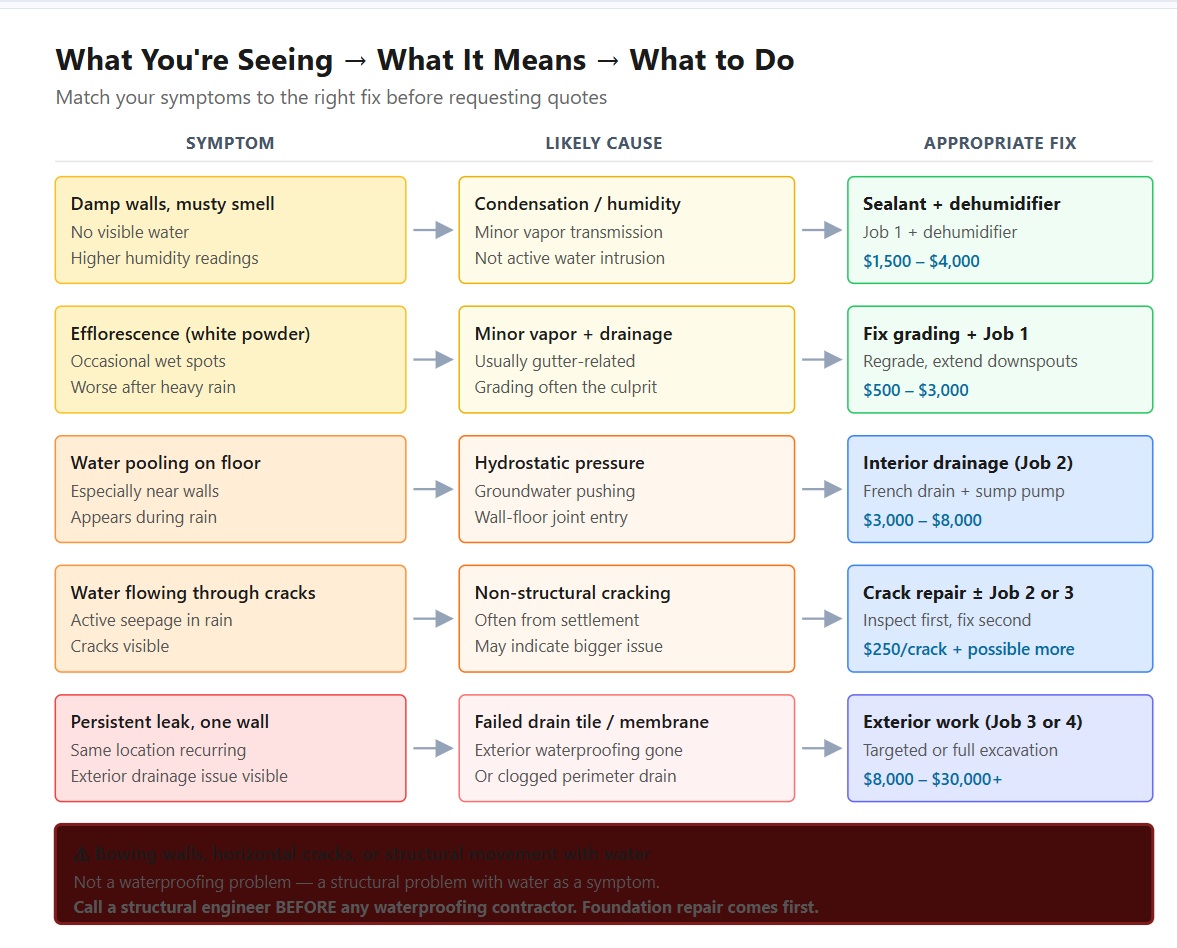
This is the section most cost articles skip. Contractors sell what they install; an interior-drainage company will quote Job 2 for everyone, and an excavation contractor will quote Job 4. Figuring out what you actually need requires working backward from the symptoms.
Damp walls, musty smell, no visible water. Likely cause: humidity and condensation, possibly minor vapor transmission through concrete. Appropriate fix: Job 1 (sealant) plus a dehumidifier. A $5,000 drainage system won’t help with a humidity problem, and contractors who try to sell you one for this are selling you the wrong product.
Efflorescence (white powder on walls), occasional wet spots after heavy rain. Likely cause: minor water vapor pushing through concrete, usually grading or gutter-related. Appropriate fix: Job 1 plus exterior drainage corrections (regrading, extending downspouts) at $500–$3,000. Often solves the problem without any interior work.
Water pooling on floor, especially near walls. Likely cause: hydrostatic pressure from groundwater pushing up or through the wall-floor joint. Appropriate fix: Job 2 (interior drainage system). This is the textbook use case for French drain plus sump pump.
Water flowing through visible cracks during or after rain. Likely cause: foundation cracks with active water intrusion. Appropriate fix: crack repair ($250–$800 per crack) if the cracks are structurally minor, possibly followed by Job 2 or Job 3 depending on whether the cracks are symptoms of a larger water issue.
Persistent leaks through one specific wall, exterior drainage visibly failing. Likely cause: failed exterior drain tile or compromised exterior waterproofing on that wall. Appropriate fix: Job 3 (targeted exterior membrane on that wall) or Job 4 if the drain tile is clearly the issue.
Bowing walls, horizontal cracks, water plus structural movement. This isn’t a waterproofing problem — it’s a structural problem with water as a symptom. You need a structural engineer before any waterproofing contractor. Foundation repair costs $5,000–$25,000+ and has to happen before or alongside waterproofing. Don’t let a waterproofing company quote you without an engineering assessment first.
A pre-work inspection by someone who doesn’t stand to profit from the fix is worth $200–$500. It’s the cheapest money you’ll spend on the project.
Interior waterproofing methods and costs
Interior methods are generally more affordable because they skip excavation. They’re also reactive — they manage water that’s already entering rather than stopping it.
Waterproof paint and sealants: $2 to $10 per square foot. DIY-possible. Works for minor moisture, not real water. A 1,000 sq ft basement runs $500–$1,500 professionally applied.
Epoxy or polyurethane crack injection: $250 to $800 per crack. Good for non-structural cracks with active seepage. Each crack is priced individually.
Interior French drain (baseboard or floor-cut): $50 to $100 per linear foot. Installed around the basement perimeter. A 150-foot perimeter runs $7,500–$15,000 for the drain itself, though most residential jobs fall in the $3,000–$8,000 range once you account for typical home sizes and partial installations.
Sump pump installation: $600 to $2,500. Required companion to interior drainage. The low end is a basic pedestal pump; the high end is a submersible pump with battery backup and high-water alarm.
Dehumidifier (dedicated basement unit): $1,200 to $2,500 installed. Not waterproofing, but frequently bundled and genuinely helpful for condensation-driven moisture.
Exterior waterproofing methods and costs
Exterior methods are the more durable fix — they stop water at the wall rather than collecting it after entry — but they require excavation, which is where the cost lives.
Excavation: $50 to $250 per linear foot. Depends on depth, soil type, and access. Clay soil and tight lots with no equipment access push the high end. This is the line item that varies most between quotes.
Liquid waterproofing membrane: $4 to $7 per square foot of wall area. Applied to the excavated foundation wall. More flexible and seamless than sheet membrane.
Sheet waterproofing membrane: $5 to $8 per square foot. Rolled and adhered to the wall. Less common in residential work.
Bentonite clay panels: $3 to $6 per square foot. Older technology still used in some applications. Expands on contact with water to seal.
Exterior drain tile (perimeter drain): $30 to $90 per linear foot. Perforated pipe in gravel at the footing level, sloped to daylight or to a sump. When exterior work is done, new drain tile is almost always part of the job.
Exterior French drain (separate from drain tile): $30 to $90 per linear foot. A surface or near-surface drain that intercepts water before it reaches the foundation. Often a cheaper partial fix than full excavation.
Backfill restoration and landscaping: $1,000 to $5,000. The forgotten line item. After excavation, the yard needs backfill, regrading, and often replanting. Make sure this is in your quote.
Interior vs. exterior: How to actually decide
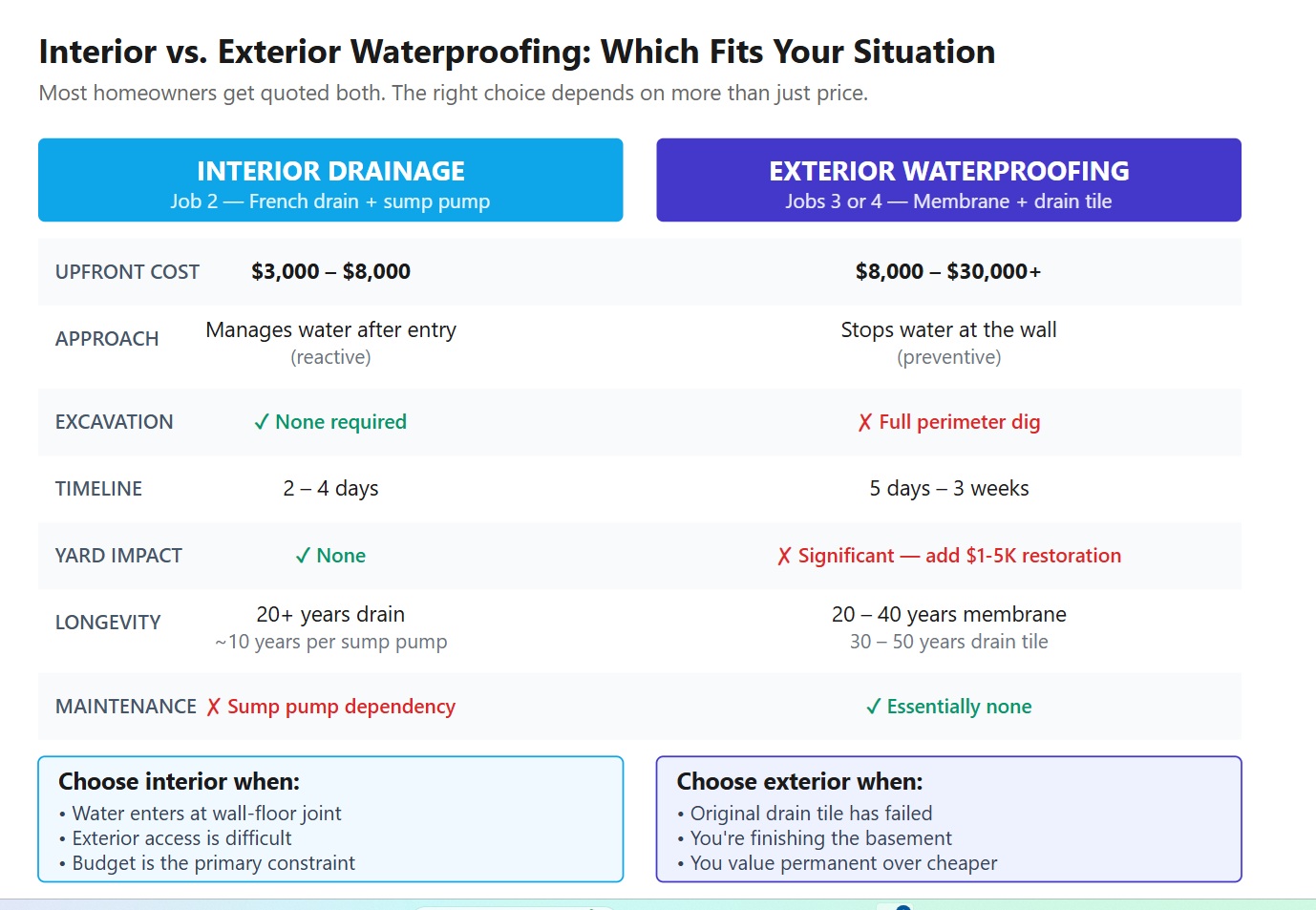
Most homeowners get quoted both. Here’s how to think about which fits your situation.
Choose interior drainage (Job 2) when: water is entering at the wall-floor joint, the foundation walls are structurally sound, excavation access is difficult or impossible (finished landscape, deck, patio, or attached garage over the problem wall), budget is constrained, and you want a reliable fix that handles hydrostatic pressure.
Choose exterior waterproofing (Job 3 or 4) when: you want to stop water at the foundation wall rather than manage it after entry, you’re doing other exterior work and the excavation cost is partially absorbed, the original waterproofing or drain tile has clearly failed, the foundation has significant cracks that need exterior repair anyway, or you plan to finish the basement and want the drier result.
The honest trade-off: exterior waterproofing costs 2–3x more upfront but lasts decades with no ongoing maintenance. Interior drainage costs less upfront but depends on a sump pump — a mechanical device with a ~10-year service life that will fail eventually, usually during the storm that needs it most. Battery backups and dual-pump systems reduce this risk but don’t eliminate it.
For homeowners who don’t plan to excavate for any other reason and don’t have structural concerns, Job 2 (interior drainage) is usually the right answer. For new construction or situations where the yard is already disturbed, exterior waterproofing is generally worth the premium.
What actually drives the price
Beyond scope choice, five variables move your quote significantly.
Foundation type. Poured concrete is cheapest to waterproof — it’s seamless and seals easily. Concrete block is moderately expensive because mortar joints need additional treatment. Stone and rubble foundations (common in pre-1950 homes) are the most expensive because their irregular surfaces require more material and more skilled labor. Stone foundations can add 30–50% to quoted prices.
Soil type and access. Heavy clay soil excavates slowly and makes backfill problematic. Rocky soil breaks equipment. Lots with no heavy-equipment access require hand excavation, which can double labor costs. Urban lots where a contractor has to protect neighboring structures during excavation run higher than suburban lots with open yards.
Depth of the foundation. A 4-foot-deep crawlspace foundation is cheaper to address than a full 8-foot basement. An 11-foot walk-out or deep basement costs more. Exterior waterproofing pricing scales almost linearly with depth because excavation cost does.
Climate and water table. Homes in high-water-table areas (near rivers, in flood plains, in regions with heavy clay) need more comprehensive systems. Northern climates with freeze-thaw cycles put more stress on waterproofing and often require more robust membranes.
Scope of damage requiring repair first. If the foundation has active structural cracks, bowing walls, or significant masonry deterioration, those repairs come first and are priced separately. Foundation repair costs $2,000–$25,000+ depending on severity. Don’t assume your waterproofing quote includes this — most don’t.
How to read and compare quotes
Contractors price differently, and comparing three quotes apples-to-apples takes some work.
Per linear foot vs. per square foot. Interior French drain is usually priced per linear foot of perimeter. Exterior membrane is usually priced per square foot of wall area. To compare, you need to know the foundation perimeter (for linear pricing) and the wall area (perimeter × depth, for square-foot pricing). Ask each contractor to give you both numbers.
What’s included vs. what’s extra. Permits ($50–$500), disposal of excavated soil ($200–$800), landscape restoration ($1,000–$5,000), electrical work for sump pumps ($200–$800), and interior wall repair after drain installation ($500–$2,000) are all commonly excluded. A $6,000 quote with these included can be cheaper than a $5,000 quote without.
Warranty terms. A “lifetime warranty” that transfers to the next homeowner, is honored after ownership changes at the contractor, and covers labor as well as materials is meaningfully different from a “lifetime warranty” that requires annual inspections and excludes most failure modes. Read the warranty document before signing.
Contractor credentials. Look for Basement Health Association membership or ICRI (International Concrete Repair Institute) certification. For structural work, require a licensed structural engineer’s involvement. For exterior work, confirm the contractor is bonded and insured for the excavation specifically, not just general work.
Timeline and disruption. Interior drainage installation is typically 2–4 days, generates a lot of dust and noise, and requires you to stay out of the basement during work. Exterior waterproofing is typically 5–10 days, tears up your yard, and often requires you to relocate outdoor items. Factor this into the decision, especially if you work from home.
Signs your foundation needs waterproofing
If you haven’t diagnosed the issue yet but suspect one, these are the common indicators:
- Visible water or pooling during or after rain
- Efflorescence (white powder) on basement walls
- Musty smell that doesn’t clear with ventilation
- Mold or mildew on walls, baseboards, or stored items
- Rust stains on appliances or metal in the basement
- Bowing, bulging, or horizontal cracks in foundation walls (structural — call an engineer, not a waterproofer)
- Peeling paint or efflorescence on interior basement walls
- Higher-than-normal humidity readings in the basement (above 60%)
- Warped flooring or baseboards near exterior walls
Any two or more of these warrants a professional inspection. A single isolated symptom might be addressable with exterior grading corrections that cost a few hundred dollars.
What about DIY?
An honest take on where DIY makes sense and where it doesn’t.
DIY-reasonable: Waterproof paint on dry basement walls (for cosmetic/humidity control, not active water), minor exterior grading corrections, extending downspouts, gutter cleaning, installing a dehumidifier. These are real fixes for real causes of basement moisture and together solve maybe 30% of residential basement water problems for a few hundred dollars.
DIY-possible but risky: Epoxy crack injection kits ($100–$300). Done right, these work. Done wrong, you’ve sealed a crack that was symptomatic of a bigger issue, and now the water finds another path. If you DIY this, do it only on narrow, non-structural cracks, and monitor after heavy rain.
Professional-only: Interior drainage system installation (requires cutting the basement floor and connecting to code-compliant drainage), any exterior excavation, any work that touches structural elements, any work that requires a permit. The insurance exposure and failure modes aren’t worth the savings.
A basement flood caused by a botched DIY waterproofing attempt will almost certainly not be covered by homeowner’s insurance. That’s the math before saving on labor.
Frequently asked questions
How long does foundation waterproofing last? Interior drainage systems last as long as the sump pump does (typically 10 years before needing replacement) with the drainage itself lasting 20+ years. Exterior membrane waterproofing lasts 20–40 years depending on material. Exterior drain tile properly installed lasts 30–50 years.
Does homeowner’s insurance cover foundation waterproofing? Generally no. Waterproofing is considered preventive maintenance. Water damage from a covered peril (burst pipe, specific storm events in some policies) may be covered, but the waterproofing fix to prevent future damage is not.
Can foundation waterproofing increase home value? A dry, waterproofed basement does increase home value and dramatically reduces time on market when selling. The return on investment varies but is typically 30–60% of the project cost in added home value, plus the insurance of avoiding a failed sale due to basement water issues disclosed during inspection.
Do I need a permit? Interior drainage work often requires a plumbing permit in many jurisdictions. Exterior excavation work usually requires a building permit. Your contractor should know local requirements — ask them to specify which permits are pulled and whether the cost is included.
How long does the work take? Interior drainage: 2–4 days. Exterior membrane with excavation: 5–10 days for one wall, 2–3 weeks for a full perimeter. Weather delays exterior work significantly.
Should I waterproof before finishing my basement? Yes, every time. Finishing a basement that has any water issue, even minor, will trap moisture behind drywall and insulation and create a much more expensive problem in 2–5 years. If you’re planning to finish, fix the water first. No exceptions.
