

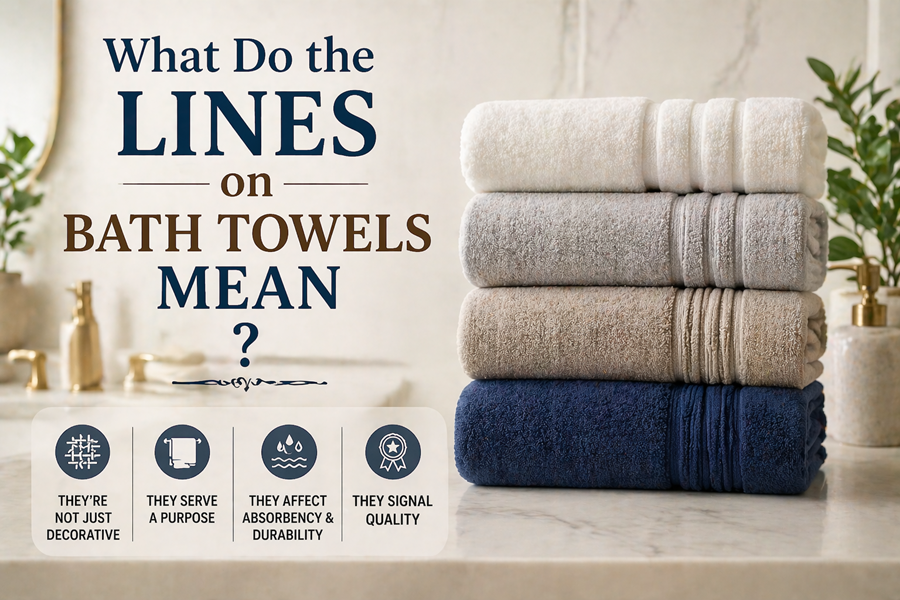
You’ve used bath towels your entire life and never questioned them. But one day — usually while folding laundry — it hits you. Every single towel you own, from the $7 one at the discount store to the $80 one from the luxury linen shop, has the same mysterious detail: a band of tightly woven horizontal lines near each end, right where the fluffy part stops. Some are subtle. Some are clearly decorative. All of them are there.
So what do the lines on bath towels mean? Are they decorative? Structural? A secret code only towel manufacturers understand? The answer is more interesting than you’d expect — it’s a mix of 19th-century textile engineering, quality signaling, and a design convention so universal that almost nobody thinks to ask about it. Once you understand what those lines are actually doing, you’ll never buy towels the same way again.
The Short Answer
Those lines are called a dobby border (sometimes spelled “dobbie”), named after the dobby loom — a specialized weaving mechanism invented in the early 1800s that allowed textile mills to produce complex patterns within a single piece of fabric. The tightly woven section you see near the ends of your bath towel serves three distinct purposes, and each one matters more than the last.
Let’s take them in order.
Why Every Bath Towel Has That Woven Border
Purpose 1: Structural reinforcement
The main body of a bath towel is made of terry cloth — a looped pile fabric where thousands of tiny uncut loops stick up from a woven base to create that absorbent, fluffy texture you actually dry off with. Terry cloth is soft and thirsty, but it’s also structurally weak. Those loops can snag, unravel, and slowly pull apart over years of washing.
The dobby border is woven in a flat, tight weave with no loops. It acts as an anchor — a structural wall at each end of the towel that prevents the terry pile from unraveling, keeps the hem stable, and stops the fabric from stretching out of shape. Without it, your towels would fray and deform within a year of regular use.
In textile engineering terms, it’s the same principle as the selvedge edge on denim or the reinforced cuff on a dress shirt. It’s a quiet piece of structural genius hiding in something most people never look at twice.
Purpose 2: A smooth surface for monogramming
Dobby borders exist partly because hotels and high-end households needed somewhere to embroider. Try monogramming directly onto terry pile and you’ll end up with a messy, uneven result — the loops don’t give the needle a consistent surface. The flat dobby band provides a stable canvas for initials, crests, or hotel logos.
This is why luxury hotels always monogram in that specific stripe, and why bespoke linen shops almost always place custom embroidery there. It’s not an aesthetic choice — it’s the only place on the towel where embroidery actually looks professional.
Purpose 3: Signaling quality (and letting you read it)
Here’s where it gets interesting for buyers. The dobby border is one of the fastest ways to tell a good towel from a mediocre one, before you even check the tag.
- Cheap towels have a thin, short dobby border — often under half an inch, loosely woven, and barely distinguishable from the main fabric. It frays quickly.
- Mid-range towels have a clearly defined border roughly one inch tall, tightly woven, and often in a subtle tonal pattern.
- Premium towels have a substantial border — an inch and a half to three inches — with distinct raised ribbing, decorative weaving patterns, or even a double-row design. This signals a higher-quality loom and more thread per square inch.
Next time you’re shopping for towels, ignore the thread count and GSM claims on the label for a moment. Run your thumb across the dobby border. If it feels flimsy or looks barely-there, the whole towel is probably built the same way.
How to Read a Towel’s Quality in 30 Seconds
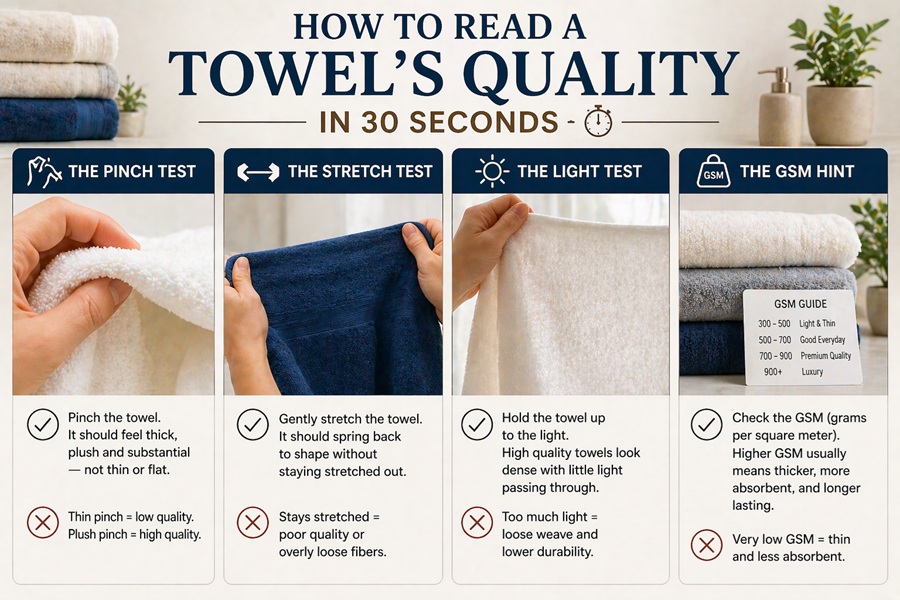
Now that you know what the lines are, you can use them as a diagnostic tool. Here’s the cheat sheet professional hotel buyers use when sourcing:
The pinch test
Pinch the dobby border between your thumb and forefinger. A quality border feels dense and slightly stiff, with visible structure. A cheap one feels thin, floppy, and almost indistinguishable from the terry pile.
The stretch test
Pull the dobby border gently in both directions. It should barely give. If it stretches easily, the weave is too loose and the hem will warp after a few washes.
The light test
Hold the towel up to a light source. Look through the dobby border. A dense, opaque band means a tight weave and more cotton per inch. A band that light passes through easily is a red flag — it’s made with less material and won’t hold up.
The GSM hint
GSM (grams per square meter) is the standard measure of towel weight. True luxury towels run 600–900 GSM. Everyday quality hits 500–600. Anything under 400 is budget territory. But GSM alone is misleading — a towel can inflate its GSM with cheap filler fiber. The dobby border tells you the real craftsmanship story.
Styling Towels Around the Dobby Border
Once you start noticing dobby borders, they become a design element — and different styles handle them very differently.
Minimalist and Scandinavian
Clean-lined, low-contrast dobby borders in tonal weaves. Think a stone-colored towel with a slightly darker stone-toned band. No embroidery, no contrast stripes. Brands like Tekla, Frama, and Uchino nail this aesthetic.
Japandi and warm minimalist
Subtle textured borders in natural, undyed cotton or linen blends. The border should feel earthy and almost invisible — texture, not color. Waffle-weave towels fit especially well into this category.
Luxury and quiet luxury
Substantial dobby borders with fine ribbing or double-banded construction, in warm neutrals — ivory, ecru, sand, mushroom, slate. Frette, Matouk, and Abyss & Habidecor are the heavy hitters here. A monogram on the dobby band is the traditional finishing touch.
Boho and collected
High-contrast dobby borders, often with Turkish-inspired weaving patterns or hand-loomed detailing. Brands like Coyuchi and Jenny Graham Home lean this direction. Stripes, tassels, and natural cotton slubs are welcome.
Coastal and modern farmhouse
Traditional stripe patterns within the dobby band — navy on white, faded terracotta on ivory. The dobby border often gets amplified into a full decorative stripe. Brooklinen and Parachute hit this note well.
Budget-friendly picks
Target’s Casaluna line, Amazon Basics’ premium cotton towels, and IKEA’s heavier cotton towels all have solid, well-constructed dobby borders for the price. These are the rare budget towels that hold up past year two.
Premium picks
For genuine investment towels: Frette Hotel Classic, Matouk Cairo, Abyss Super Pile, and Weezie. All feature the substantial, tightly-woven borders that survive a decade of daily use.
The Design Psychology — Why These Lines Work Visually
The dobby border isn’t just structural. It performs a specific visual function that designers exploit consciously.
Framing effect. The human eye naturally treats a contrasting border as a visual frame, telling the brain “this object is complete and finished.” A bath towel without a dobby border reads as a raw piece of fabric. With one, it reads as a considered, finished object — even though 95% of the towel is identical.
Horizontal line grounding. Horizontal lines universally signal stability and calm in interior design. When stacked on a shelf, towels with visible dobby borders create rhythmic horizontal bands that the eye finds pleasing and orderly. This is why luxury hotels display towels rolled or stacked with the borders facing out — it makes the linen closet feel composed rather than chaotic.
Quality signaling through pattern. The brain reads visible craftsmanship as quality, even without consciously analyzing it. A clearly woven dobby border registers as “someone made this carefully,” which is why high-end brands emphasize the detail rather than hide it.
Mistakes That Quietly Ruin Nice Towels
- Tumble-drying on high heat. Heat slowly breaks down the tight weave of the dobby border. Medium heat or air-drying preserves it for years longer.
- Using fabric softener. Fabric softener coats cotton fibers with a waxy residue that reduces absorbency and stiffens the dobby border unnaturally. Use white vinegar in the rinse cycle instead.
- Ignoring fraying at the border. Small loose threads at the dobby band are the first sign of wear. Trim them immediately with scissors — never pull, which unravels the weave.
- Hanging wet towels on thin hooks. The concentrated weight stretches the dobby border and eventually deforms it. Use wide bars or thick hooks.
- Buying exclusively by GSM. A heavy towel with a flimsy dobby border will fall apart faster than a lighter one with solid construction. Always inspect the border.
- Matching towel sets from big-box stores. The “eight-piece sets” often skimp on construction across every piece. One well-made towel with a proper dobby border outperforms three bargain towels.
Frequently Asked Questions
What do the lines on bath towels mean?
Those lines are called the dobby border, a tightly woven flat band near each end of the towel. They serve three purposes: reinforcing the structure so the fabric doesn’t unravel, providing a smooth surface for monogramming or embroidery, and serving as a visual quality indicator — the thicker and denser the border, the higher the craftsmanship.
Why are they called dobby borders?
They’re named after the dobby loom, a 19th-century weaving mechanism that allowed textile mills to weave complex patterns within a single piece of fabric. The loom was invented specifically to create decorative-yet-functional details like this border.
Do all bath towels have dobby borders?
Nearly all do, though some modern designs hide or minimize them. Waffle-weave towels often skip the border since the entire fabric has structural rigidity. Turkish peshtemal towels also frequently omit traditional dobby bands in favor of fringed edges.
Can I tell towel quality just by looking at the dobby border?
Largely, yes. A thick, tightly woven, dense dobby border (an inch or more, with visible ribbing) signals a well-constructed towel. A thin, loosely woven border that barely differs from the terry pile usually means lower-quality construction throughout.
What GSM is best for bath towels?
500–600 GSM is ideal for everyday use — soft, absorbent, and fast-drying. 600–900 GSM delivers true luxury feel but takes longer to dry and can feel heavy. Below 400 GSM is thin, hotel-gym territory. Always pair GSM with a dobby border inspection — both matter.
How should I store bath towels to preserve the borders?
Fold or roll with the dobby borders facing out, and store on open shelves or in linen closets with breathing room. Avoid cramming towels tightly, which crushes the border weave over time.
The Takeaway
So, what do the lines on bath towels mean? They’re a tiny masterclass in functional design — structural reinforcement, embroidery canvas, and quality marker all woven into one small band most people never notice. Once you know to look at them, they become the single fastest way to judge a towel before you buy it, and a quiet design detail that separates a considered bathroom from a forgettable one.
Run your thumb across the dobby border. If it’s dense, tight, and clearly made — the towel is worth owning. If it’s thin and limp — put it back. That’s the entire trick, hiding in plain sight on every bath towel you’ve ever used.
