

Crawl space foundation repair costs between $250 and $40,000 depending on the problem and the fix. Minor crack sealing runs $250 to $1,500. Replacing a damaged support beam runs $1,500 to $5,000. Installing piers to stop foundation settlement runs $3,000 to $25,000+ depending on how many piers your home needs. A full structural stabilization with wall reinforcement and underpinning can push past $40,000.
The reason quotes vary so wildly isn’t bad faith — it’s that “crawl space foundation repair” covers at least six genuinely different jobs, and contractors quote different scopes based on what they see when they crawl under your house. Before signing anything, you need to understand which scope you’re actually buying.
This guide breaks down what each scope costs, how to tell which one your house needs, and one piece of advice that could save you tens of thousands of dollars: when to hire a structural engineer before you hire a contractor.
Six Scopes Hiding Behind Crawl Space Foundation Repair
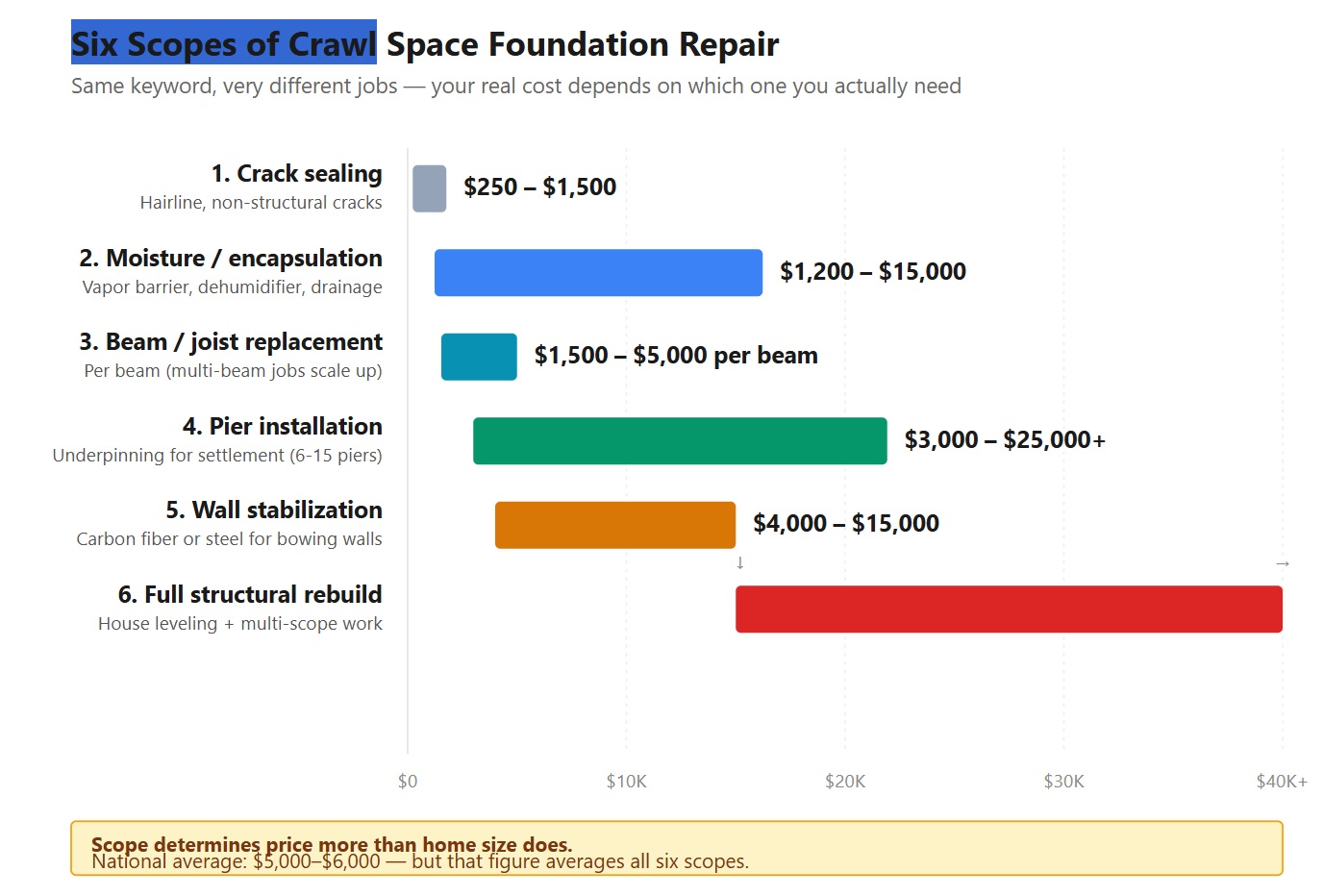
Different problems require different fixes. The first step in budgeting is figuring out which of these six conversations you’re actually in.
Scope 1: Minor crack sealing — $250 to $1,500.
Hairline cracks in foundation walls or piers, sealed with epoxy or polyurethane injection. Appropriate when cracks are non-structural — narrow, vertical, and not associated with movement elsewhere in the house. The cheapest legitimate foundation work.
Scope 2: Moisture and encapsulation work — $1,200 to $15,000.
Vapor barriers, dehumidifiers, sump pumps, sealed vents, perimeter drainage. Addresses moisture problems that cause mold, wood rot, and pest issues but not structural failure. Often pitched as “foundation repair” but is technically moisture management. Critical to address but doesn’t fix structural problems on its own.
Scope 3: Beam or joist replacement — $1,500 to $5,000 per beam.
Replacing rotted, sagging, or damaged structural members under your home. Required when wood members have failed from moisture, termites, or age. Includes temporary jacks to support the house during the work. A single beam replacement is straightforward; multiple beam replacements with widespread joist damage runs $10,000 to $20,000+.
Scope 4: Pier installation and underpinning — $1,000 to $3,000 per pier; $3,000 to $25,000+ total.
Installing supportive piers that reach down to stable soil or bedrock to stop foundation settlement. The standard fix for a sinking or shifting foundation. Most homes need 6 to 15 piers depending on the affected area. Helical, push, and concrete piers each have different applications and price points.
Scope 5: Wall stabilization — $4,000 to $15,000.
Stopping foundation walls from continuing to bow inward under soil pressure. Carbon fiber straps run $500 to $800 per strap and are appropriate for early-stage bowing. Steel I-beams or wall anchors run $700 to $1,500 per unit and handle more severe cases. Required when walls have moved more than minor amounts.
Scope 6: Full structural rebuild — $15,000 to $40,000+.
Major work involving multiple repair types together. Common scope: house leveling with new piers, beam replacement, plus moisture remediation. This is what severe, neglected foundation problems require. Often financed because it’s beyond most homeowners’ cash budgets.
The national average for crawl space foundation repair lands around $5,000 to $6,000, but that figure averages across all scopes. Your specific number depends on which of the six scopes your house actually needs.
How to tell which scope you need
The diagnostic process matters because contractors specialize. A waterproofing company will recommend Scope 2. A pier company will recommend Scope 4. Both might be honest about what they see, but they may not see the bigger picture.
Sticking doors and windows that didn’t stick before. Indicates differential settlement — part of your foundation is moving relative to the rest. Likely needs Scope 4 (pier installation). Cost: $3,000 to $25,000+ depending on extent.
Sagging floors, especially in the middle of rooms. Usually indicates failed support beams or joists in the crawl space. Likely needs Scope 3 (beam/joist replacement). Cost: $1,500 to $20,000 depending on how much wood has failed.
Cracks in interior walls, especially over doorways or in stair-step patterns on brick. Stair-step cracks in masonry indicate foundation settlement. Vertical hairline cracks in drywall are usually cosmetic. Diagonal cracks wider than 1/4 inch suggest active movement. Likely needs Scope 1 if minor, Scope 4 if associated with other settlement signs.
Bowing or leaning foundation walls. Lateral soil pressure has exceeded what the wall can resist. Always needs Scope 5. Sometimes also needs Scope 4 if footings have moved. Cost: $4,000 to $15,000+.
Water in the crawl space, musty smell, mold visible. Moisture problem, not structural — unless the moisture has been ongoing long enough to rot beams or joists, in which case it’s now both. Needs Scope 2, plus Scope 3 if wood damage exists. Cost: $1,500 to $15,000+.
Visible cracks in foundation walls or piers, no other symptoms. May be cosmetic, may be early-warning. Get an inspection. If non-structural, Scope 1. If associated with movement, Scope 4.
Pest infestation, especially termites or carpenter ants in crawl space wood. Not foundation repair per se, but pest damage often necessitates Scope 3 if wood members have been compromised. Get pest treatment first, then assess structural damage.
Floors that bounce or feel spongy when walked on. Inadequate joist support — joists too widely spaced, undersized, or partially failed. Scope 3 with possible additional joist sistering. Cost: $2,000 to $8,000.
Multiple symptoms at once. Stop trying to self-diagnose and read the next section.
The advice that saves homeowners thousands
If you’re seeing structural symptoms — sticking doors, settling cracks, bowing walls, sagging floors — pay a structural engineer for an independent assessment before you get contractor quotes.
Here’s why this matters. Contractor estimates from foundation repair companies typically cost $0 to $260 and come with a sales pitch attached. The contractor’s incentive is to find work to sell you. They may genuinely believe their recommendation, but the recommendation will reflect what their company installs. A pier company will see a pier problem. A waterproofing company will see a waterproofing problem.
A structural engineer’s inspection runs $250 to $1,000 and produces an unbiased report — they don’t sell repairs, they sell analysis. The engineer tells you what’s actually wrong, what scope of work is genuinely required, and what specifications the work needs to meet. You then take that report to contractors and request quotes for the specific scope the engineer identified.
The math: paying $500 to learn that the contractor’s $25,000 underpinning recommendation is actually a $4,000 wall anchor problem is a ~$20,000 saving. Even on smaller jobs, an engineer’s assessment ensures the work matches the actual problem.
When to skip the engineer: minor cracks with no other symptoms, moisture-only issues with no structural concerns, or beam replacement where the damage is obvious and isolated. When to insist on one: anything involving multiple symptoms, anything where contractors are giving you wildly different quotes, anything involving piers or wall stabilization, or anything you suspect might be larger than the contractor is letting on.
Pier method comparison: which one actually fits
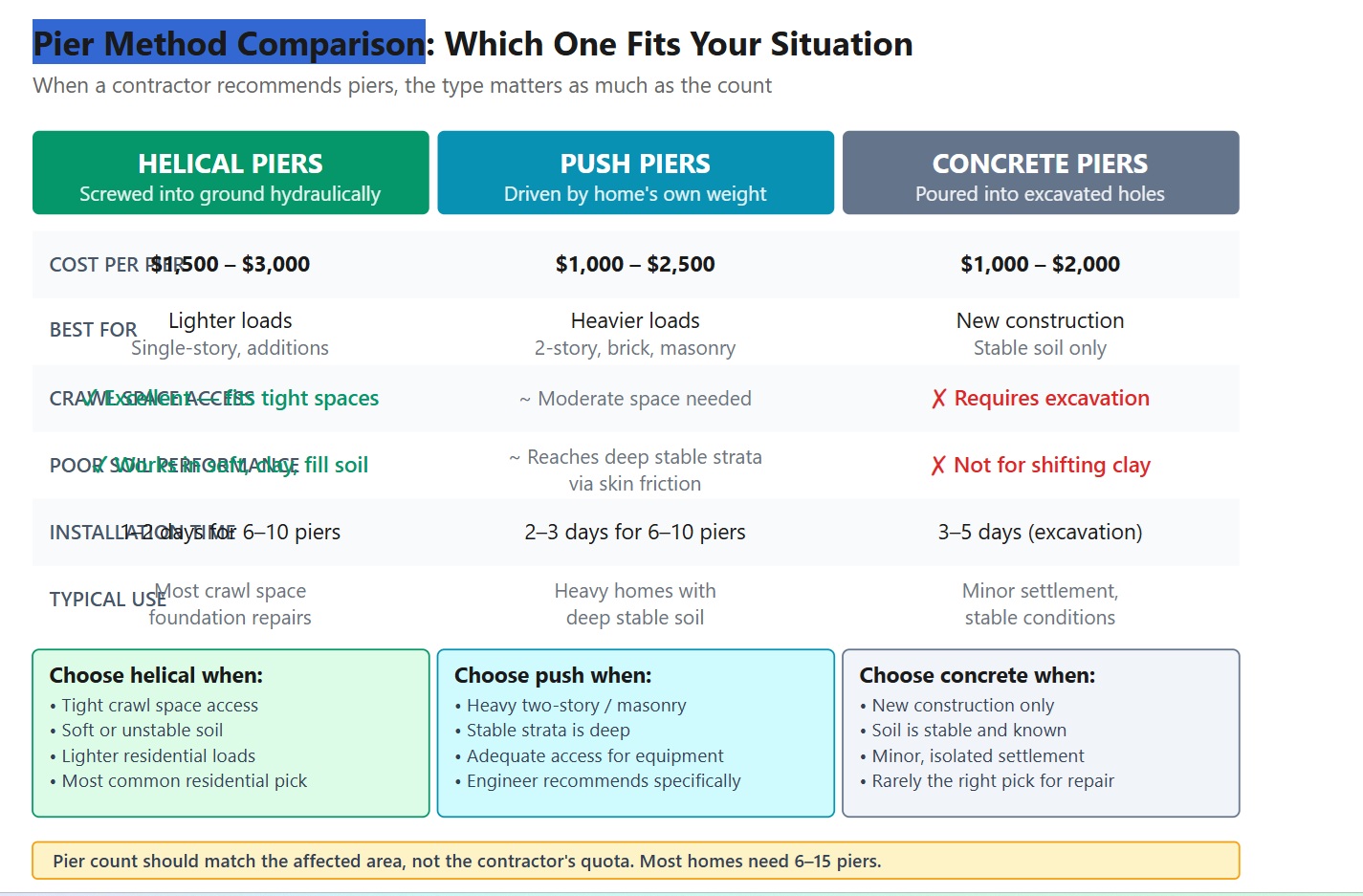
Pier installation is where the highest-dollar quotes happen, and it’s where the method matters most. Three main types are used residentially.
Helical piers — $1,500 to $3,000 per pier installed. Steel piers with helix-shaped plates that screw into the ground. Installation is hydraulic, doesn’t require excavation, and works in tight crawl spaces. Best for lighter loads (single-story homes, additions, light commercial). Can be installed in poor soil that other piers can’t handle. Typically the most appropriate choice for crawl space foundation work because they install through limited access.
Push piers (resistance piers) — $1,000 to $2,500 per pier installed. Steel piers driven into the ground using the weight of the home itself for resistance. Reach deeper than helicals into stable strata. Best for heavier loads (two-story homes, brick or masonry construction). Require somewhat more installation space.
Concrete piers (poured-in-place) — $1,000 to $2,000 per pier. Concrete piers poured into excavated holes. Cheapest material but limited depth, less effective in shifting clay soils. Mostly used for new construction or minor settlement repairs in stable soil. Generally not the right choice for active settlement problems.
A typical crawl space foundation repair using piers needs 6 to 15 piers depending on how much of the foundation is affected. At $1,500 to $3,000 per helical pier, that’s $9,000 to $45,000 in pier costs alone. Add structural assessment, permits, and any additional work and you’re looking at the upper range of crawl space foundation repair budgets.
If a contractor proposes 4 piers for a problem that’s affecting most of one wall, ask why. If they propose 30 piers for what looks like localized settlement, ask why. The pier count should match the actual area of failure.
What actually drives the price
Beyond scope and pier method, six factors create most of the variance between quotes.
Crawl space accessibility. The biggest cost driver homeowners don’t think about. Crawl spaces under 18 inches tall require workers to belly-crawl and move materials by hand. Spaces under 24 inches significantly slow work. Crawl spaces with restricted access points (small doors, blocked routes) add hours per task. A 36-inch crawl space costs significantly less to repair than a 20-inch crawl space because labor is faster.
Soil conditions. Expansive clay soils (common in Texas, parts of the Midwest, the Southeast) cause more foundation movement and require deeper piers, which costs more. Sandy or gravelly soils are typically cheaper to work in. Rocky soils may require specialty equipment. Saturated soils require dewatering before work begins.
Number of piers needed. Pier count is determined by how much of the foundation is affected. Localized settlement (one corner) might need 4 to 6 piers. Single-wall settlement might need 8 to 12 piers. Multi-wall or whole-perimeter settlement needs 15 to 30+ piers. Each additional pier adds $1,000 to $3,000.
Concurrent moisture damage. If structural problems are accompanied by wood rot, mold, or pest damage, the project scope expands. Contractors rarely fix structural problems without also addressing the moisture that caused them, because doing only the structural work guarantees the problem returns. Budget 20–40% more than the structural-only quote if moisture damage is present.
Region. High-cost metros (West Coast, Northeast) run 25–40% above national averages. The Southeast and Texas have lower base costs but higher problem prevalence due to soil. Engineers and specialists in dense markets cost more; rural areas may have fewer qualified contractors competing.
Permits and inspections. Crawl space foundation work often requires building permits ($150 to $500 typical) and may require structural engineering plans ($500 to $2,500). Permits typically add 1–3% to total cost; engineering adds 2–5%.
What a complete quote should include
A quote that looks cheap usually has line items missing. Before signing, verify the quote covers each of the following.
Diagnosis and engineering. Either the contractor’s structural engineer’s stamp on the plan or a reference to your independent engineer’s report. “We’ll figure it out as we go” is not acceptable for foundation work.
Specific repair scope. Number of piers (with type — helical, push, or concrete), specific beams or joists to replace, specific walls to stabilize. “Foundation repair” is not a scope; numbers and locations are.
Temporary support during work. Hydraulic jacks, cribbing, or other temporary support to hold the house steady during the repair. This is included in any reputable quote.
Permits and inspections. Either pulled by the contractor (preferred) or specified as the homeowner’s responsibility with cost noted.
Site protection and cleanup. Crawl space work generates dirt, debris, and damaged material that needs removal. Yard restoration if excavation is required.
Warranty terms. Lifetime, transferable warranties from major foundation companies are common but vary significantly in fine print. Read carefully.
Concurrent moisture work, if any. If the contractor recommends moisture control alongside structural work, the moisture scope should be itemized separately so you can decide whether to bundle it or sequence it.
Insurance and licensing. General liability, workers’ comp, state contractor license where required. Foundation work on residential structures often requires specific licensing.
A quote that’s significantly cheaper than competing quotes for the same scope is usually missing one of these line items, often more than one.
Is this an emergency or can it wait?
A common question and an honest answer: most foundation problems are not immediate emergencies. Settlement, bowing, and beam damage typically progress over months and years, not days. Waiting weeks to schedule repairs is usually fine. Waiting years is usually how small problems become big ones.
Genuine emergencies — get help within days, not weeks:
- Sudden new cracks (week to week) that are widening visibly
- Doors that suddenly won’t open or close at all
- Floors visibly sloping more than they used to
- Visible separation of walls from ceilings or floors
- Wall bowing that has accelerated noticeably
- Standing water in the crawl space combined with structural symptoms
Address within 1–6 months:
- Established settlement cracks that have been stable but exist
- Sticking doors that have gradually gotten worse
- Sagging floors with no obvious deterioration
- Long-standing moisture issues that haven’t yet caused structural damage
Monitor and address within 1–3 years:
- Hairline cracks that aren’t changing
- Minor sticking that’s seasonal (humidity-related)
- Crawl space moisture without visible wood damage
The risk of waiting too long isn’t usually catastrophic failure — it’s that the problem grows from a $5,000 fix to a $25,000 fix as additional damage accumulates. Foundation problems compound; getting in front of them while small is the cheapest version of the work.
DIY: where it makes sense and where it doesn’t
Most crawl space foundation repair is professional-only. The work involves structural engineering, specialized equipment, permits, and consequences that range from inconvenient to catastrophic if done wrong.
DIY-reasonable: Vapor barrier replacement (6-mil polyethylene sheeting, $300 to $800 in materials, weekend project for someone willing to crawl), basic moisture monitoring with a humidity sensor, gutter and downspout improvements that reduce moisture reaching the foundation, drainage corrections (regrading, extending downspouts) on the surface around the house. These are real fixes for real moisture problems and address some of the underlying causes of structural damage.
Professional-only: All structural work. Beam or joist replacement requires temporary support of your house. Pier installation requires specialized hydraulic equipment. Wall stabilization requires engineering. Crack injection beyond hairline cosmetic cracks requires assessment of underlying causes. Anything requiring a permit.
The honest reason: a botched crawl space foundation repair can collapse a section of your house. Insurance typically won’t cover damage caused by unlicensed work. The savings from DIY are small relative to total project cost; the downside risk is large.
Frequently asked questions
How long does crawl space foundation repair take?
Minor work (vapor barrier, crack injection, single beam) typically takes 1 to 3 days. Pier installation typically takes 2 to 7 days. Major structural work or full underpinning takes 1 to 3 weeks. Add inspection, engineering, and permit time on the front end — often 2 to 8 weeks before work starts.
Will homeowner’s insurance cover foundation repair?
Generally no. Foundation movement from soil settlement, expansive clay, or general age is considered maintenance, not a covered peril. Insurance may cover foundation damage from a specific covered event (earthquake if endorsed, sudden plumbing leaks, vehicle impact). Always check your policy and document any sudden-event triggers.
Does foundation repair add value to my home?
Repaired foundations don’t add value the way a kitchen renovation does — a house with a sound foundation isn’t more valuable than a comparable house. But unrepaired foundation problems significantly reduce home value at sale and often kill deals during inspection. The value of repair is primarily in protecting the home’s existing value and enabling future sale.
How long do foundation repairs last?
Properly installed helical and push piers come with lifetime, transferable warranties from major manufacturers and last as long as the house. Wall stabilization with carbon fiber or steel typically warranties for the life of the home. Beam replacement lasts as long as the wood and the moisture environment allows — typically 30+ years if moisture is also addressed.
What’s the difference between encapsulation and waterproofing?
Encapsulation is the comprehensive sealing of a crawl space — vapor barrier on floor and walls, sealed vents, conditioned air or dehumidifier, insulation. Waterproofing is the addition of drainage to manage water that enters the space. Both address moisture; encapsulation is more comprehensive and more expensive ($5,000 to $15,000) than basic waterproofing ($1,500 to $5,000).
Can I get foundation repair financed?
Yes, most major foundation repair companies offer financing through partners. Home equity loans and lines of credit are also commonly used. For severe damage that’s affecting habitability, FHA 203(k) renovation loans can fund foundation repair as part of a larger refinance.
Should I get the foundation inspected before buying a home?
Yes, especially in regions with expansive clay soils or where the home is over 30 years old. A foundation-specific inspection from a structural engineer ($300 to $700) goes beyond what general home inspectors typically cover. Foundation problems found before closing are negotiable; found after are your problem.
My contractor says I need 30 piers. Is that realistic?
Sometimes yes, often no. Pier count should match the area of actual settlement. A whole-perimeter underpinning of a large home can legitimately need 25 to 40 piers. Localized settlement in one corner needs 4 to 8. If a contractor’s pier count seems high relative to the visible problem area, get a second opinion or a structural engineer’s assessment first.
