

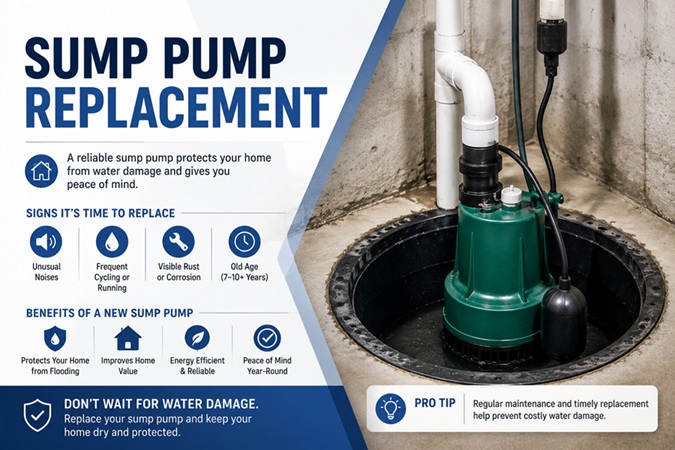
A sump pump replacement costs $300 to $2,500 for most homeowners, with the headline number depending heavily on which of five different jobs you’re actually buying. A basic pedestal pump swap in an accessible basement runs $310 to $600. A submersible swap in the same basement runs $400 to $1,000. A complete submersible-plus-battery-backup combo system runs $1,200 to $2,500. Crawl space installations add roughly 30 percent to the basement price because of access difficulty. Outdoor sump pumps run $1,250 to $2,500.
If your pump just failed and you’re trying to figure out what’s reasonable to pay, the wide range across cost guides ($120 on the low end, $4,775 on the high end) reflects this scope variance, not bad faith on anyone’s part. This guide breaks down what each replacement scenario actually costs, when repair makes more sense than replacement, and why emergency calls cost meaningfully more than planned ones.
Five replacement scenarios, five different price points
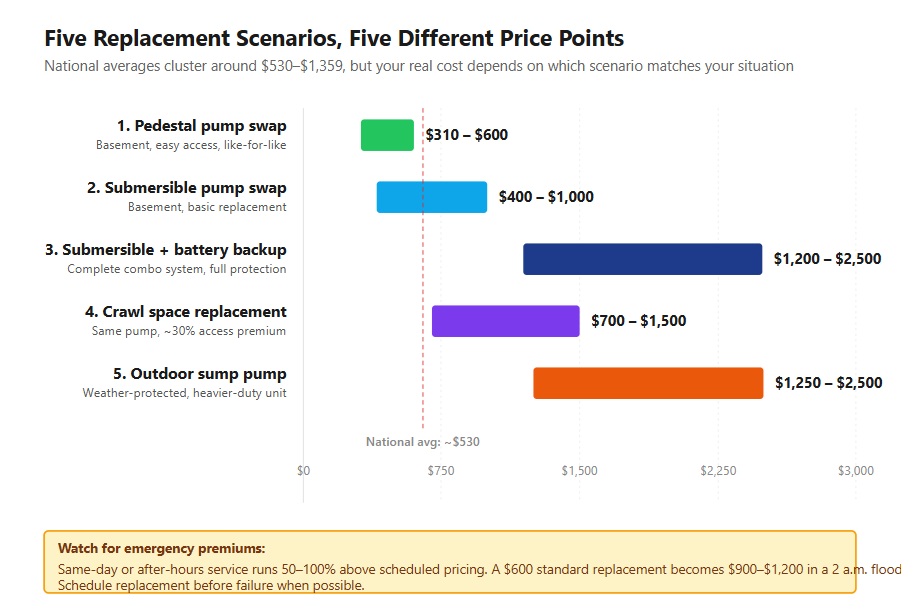
Before comparing any quotes, figure out which of these five jobs matches your situation.
Basic pedestal pump swap (basement) — $310 to $600
Removing the old pedestal pump from its existing pit, installing a new one in the same location, connecting to existing discharge piping. The cheapest option because pedestal pumps themselves cost $60 to $170 and the swap takes roughly an hour. Pedestal pumps sit above the pit with the motor exposed, which makes them easier to service and cheaper, but louder than submersibles and slightly more prone to clogging. With routine care, a quality pedestal pump lasts up to 25 years.
Basic submersible pump swap (basement) — $400 to $1,000
Same scenario, but with a submersible pump that sits underwater inside the pit. Submersibles cost $100 to $400 for the unit, run quieter than pedestals, and handle higher water volumes. They’re the more common residential choice today. Average lifespan runs 7 to 10 years — shorter than pedestal pumps, which is why submersibles need replacement more often.
Submersible plus battery backup combo — $1,200 to $2,500
The full system most basement waterproofing companies recommend. Includes a primary submersible pump, a secondary battery-powered backup pump that activates if the primary fails or loses power, a battery (deep-cycle marine type), a charger, and an alarm. The price reflects the combined hardware plus the more involved installation. This is the appropriate setup for homes in flood-prone areas, regions with frequent power outages, or anywhere a basement flood would cause significant damage.
Crawl space replacement — $700 to $1,500
Same pump, more difficult installation. Crawl spaces under 24 inches require workers to crawl on their stomachs and move materials by hand. Tighter access slows work and increases labor costs. Crawl space installations run roughly 30 percent higher than the same job in a standard basement.
Outdoor sump pump replacement — $1,250 to $2,500
Outdoor pumps must withstand heat, cold, sun exposure, and continuous moisture. The pumps themselves are heavier-duty (and more expensive), and the installation often involves additional weather protection — pit caps, freeze protection, sometimes new discharge routing. Common in regions with high water tables or properties with significant yard drainage requirements.
National averages cluster around $530 to $1,359 across cost-guide sources, but those averages mask which scenario you’re actually in. Your real budget depends on which of these five replacements matches your situation.
The repair-vs-replace decision
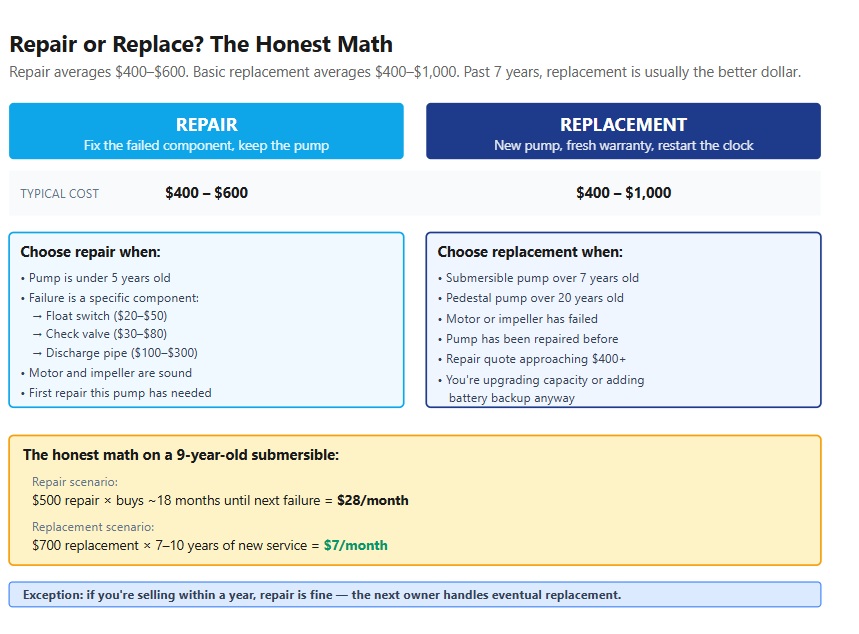
Sump pump repair runs $400 to $600 on average. That’s close enough to the cost of a basic replacement that the math deserves attention before you pay a plumber to fix what might be cheaper to replace.
Repair makes sense when:
- The pump is under 5 years old
- The failure is a specific replaceable component (float switch, check valve, discharge pipe)
- The motor and impeller are functioning normally
- This is the first repair the pump has needed
Replacement makes sense when:
- The pump is over 7 years old (submersible) or over 20 years old (pedestal)
- The motor or impeller has failed
- The pump has been repaired before and is failing again
- Repair quote is approaching $400+
The honest math: a $500 repair on a 9-year-old submersible buys you maybe 1 to 2 more years of service before the next failure. That’s $500 amortized over 18 months — about $28 per month — for a system that might fail again at any point. A $700 replacement buys 7 to 10 years of new service, working out to roughly $7 per month. Replacement is almost always the better long-term value past the 7-year mark on a submersible pump.
The exception: if you’re selling the home within a year, repair is fine. The next owner will deal with the eventual replacement on their schedule.
Why emergency calls cost more
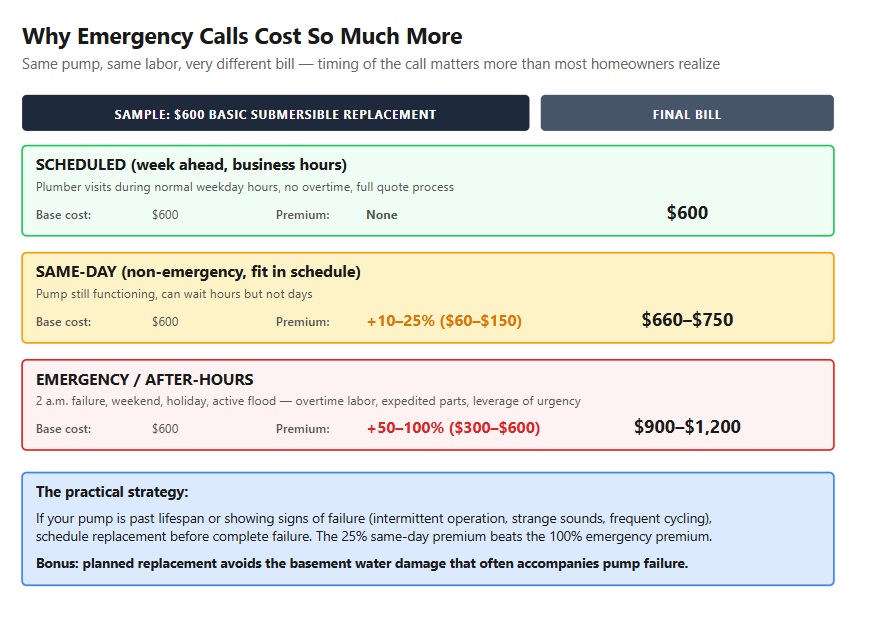
Most sump pump failures aren’t discovered during a calm afternoon. They’re discovered during the storm that the pump was supposed to handle, or the morning after, when the basement has water in it. That timing has real cost implications.
Emergency or after-hours service: 50 to 100 percent premium over standard pricing
A $600 standard replacement becomes $900 to $1,200 if the plumber comes out on Sunday evening or at 2 a.m. during a flood. The premium covers actual costs (overtime labor, expedited parts) plus the leverage the situation creates — you don’t have time to get three quotes when water is rising.
Standard scheduled service: base pricing applies
Calling Monday morning for a “this week if possible” appointment gets you the prices in the scenarios above without premium.
Same-day non-emergency: typically 10 to 25 percent premium
Most plumbers will fit a same-day call into the schedule for a small bump in price, especially if the pump is still functioning enough to keep up.
The practical takeaway: if your pump is showing signs of failure (intermittent operation, strange sounds, frequent cycling, age past lifespan), schedule replacement before complete failure. The 25 percent same-day premium beats the 100 percent emergency premium, and the planned-replacement experience is dramatically less stressful than the emergency one.
What drives price within each scenario
Beyond the basic scope, six factors create most of the variance between quotes.
Pump capacity (horsepower)
Standard residential pumps run 1/3 to 3/4 horsepower. A 1/3 HP pump handles most homes with normal water tables. A 1/2 HP pump suits homes with higher water volumes or longer discharge runs. A 3/4 HP pump is necessary for homes with severe water issues or unusual setups. Each step up in horsepower adds $50 to $200 to the unit cost.
Discharge piping condition
If existing discharge pipe is corroded, undersized, or improperly routed, the replacement may include new piping. Replacing 20 feet of discharge pipe adds $150 to $400 in materials and labor.
Electrical work
Sump pumps need a dedicated circuit by code in most jurisdictions. If your existing setup uses an extension cord or a shared circuit (both common in older homes), bringing the installation to code adds $200 to $600 for an electrician’s visit.
Pit condition and size
Existing pits sometimes need cleaning, repair, or resizing for the new pump. A clogged or undersized pit adds $100 to $400. Installing a brand-new pit (where none existed before) runs $1,000 to $2,500.
Backup battery quality
Standard marine batteries cost $80 to $200 and last 3 to 5 years. Premium AGM batteries cost $150 to $300 and last 5 to 8 years. Lithium batteries are the longest-lasting at 8 to 12 years but run $400 to $800. Worth investing in a quality battery if a backup pump is part of the system — a backup pump with a dead battery is no backup at all.
Region
High-cost metros (Northeast, West Coast, major Texas metros) run 25 to 40 percent above national averages. Rural areas typically run lower base costs but may have fewer plumbers competing on price. Regional codes around dedicated circuits and backup requirements also vary.
What’s in a complete quote
A quote that looks cheap usually has line items missing. Before signing, verify the quote covers each of the following.
The pump itself
Type (pedestal vs. submersible), horsepower, manufacturer, model number. Don’t accept “good quality pump” as a specification — get the model in writing so you can verify warranty terms and replacement parts availability.
Labor for removal and installation
Removing the old pump, hauling it away, installing the new pump, connecting to existing piping. Most basic swaps take an hour or two of skilled labor.
Discharge piping work
Whether existing pipe is being reused, partially replaced, or fully replaced. The quote should specify.
Electrical compliance
Whether the existing electrical setup meets code, and if not, what’s needed to bring it to code. Surprises here are the most common source of “the bill grew” complaints from homeowners.
Battery backup (if included)
Battery type, brand, age (sometimes batteries are sold “new” but have been on the shelf for months), expected lifespan, charger specifications.
Disposal of the old pump
Most plumbers include this; some don’t. Should be specified.
Cleanup
Sump pumps move dirty water with sediment. Replacement work involves some mess that should be cleaned up before the plumber leaves.
Warranty terms
Manufacturer warranty on the pump itself (typically 1 to 3 years), labor warranty from the plumber (typically 90 days to 1 year), and what’s excluded.
A complete quote for a basic basement submersible replacement should land in the $400 to $1,000 range and itemize each of these. Significantly cheaper quotes typically omit the electrical compliance check or the warranty.
DIY: when it actually works
Sump pump replacement is one of the few major plumbing tasks where DIY genuinely makes sense for some homeowners and is genuinely a bad idea for others.
DIY-reasonable when all of these are true:
- The replacement is a like-for-like swap (same pump type, same horsepower, same pit)
- Existing discharge piping is in good condition
- Existing electrical setup is already to code
- The pit is in an accessible basement (not a crawl space)
- You have basic plumbing and electrical comfort
- You’re not in an active flood situation
A pump in this scenario costs $100 to $400 in materials. The work takes 1 to 3 hours. You save the $250 to $400 in labor. Net DIY savings: $150 to $300.
DIY-bad-idea when any of these apply:
- The pump capacity needs upgrading
- Discharge piping needs replacement or rerouting
- Electrical work is involved
- The installation is in a crawl space or outdoor location
- Battery backup system is being added or upgraded
- You’re in a flood situation and need it working in the next hour
The wrong DIY in this category creates worse problems than the original. Improper electrical work creates fire hazards and voids insurance. Undersized discharge pipe causes pump cycling that destroys the new pump within months. A poorly mounted submersible doesn’t fully drain the pit, leaving water against the foundation.
Safety note for DIY-reasonable installations: Always disconnect electrical power at the breaker before any work. Sump pump pits collect groundwater that can be electrified through the pump motor if wiring is damaged. The breaker stays off until the new pump is fully installed and the breaker side is verified safe.
Lifespan and replacement strategy
Sump pumps don’t last forever. Planning replacement before failure is meaningfully cheaper than reacting to failure.
Submersible pumps: Average 7 to 10 years. Plan for replacement around year 7 even if it’s still running. The cost of proactive replacement ($400 to $1,000) is roughly the same as reactive replacement, but you avoid the emergency premium and the basement water damage that often accompanies pump failure.
Pedestal pumps: Average 15 to 25 years with proper care. Less urgent on the proactive replacement schedule, but worth inspecting annually past year 10.
Battery backups: Batteries fail before the backup pump itself does. Replace the battery on a 3 to 5 year cycle for standard marine batteries, or test it yearly to verify charge and capacity.
Float switches: The single most common point of failure in any sump pump. They cost $20 to $50 to replace and 10 minutes of work. Test them yearly by lifting the float manually to verify the pump activates.
The honest budgeting framework: every 7 to 10 years, the submersible pump itself needs replacement. Every 3 to 5 years, the backup battery needs replacement. Every 15 to 25 years, the entire system (including the pit if degraded) may need overhaul. Spread across 25 years, sump pump maintenance averages $80 to $150 per year — much cheaper than even a single basement flood.
Frequently asked questions
How long does sump pump replacement take?
A basic basement swap with no complications takes 1 to 3 hours. Adding a battery backup adds 1 to 2 hours. New pit installation or significant electrical work can extend the project to a full day. Most replacements are completed in a single visit.
Should I be home for the replacement?
Helpful but not strictly required. Being home lets you ask questions and verify the new pump is functioning before the plumber leaves. If you can’t be home, request photos of the completed work and a written confirmation that the pump was tested under load.
Will sump pump replacement disrupt my plumbing or water service?
No. The sump system is independent of your home’s water supply and drainage. Replacement work happens at the pit and discharge line, with no impact on faucets, toilets, or appliances.
Does homeowner’s insurance cover sump pump replacement?
Generally no. The pump itself is considered maintenance equipment. Insurance may cover water damage caused by a sudden pump failure (depending on policy specifics and whether you have a sewer/water backup endorsement), but typically not the replacement of the failed pump. Some home warranty plans do cover sump pump replacement, often with a deductible — worth checking your warranty before paying out of pocket.
Can I install a sump pump where one didn’t previously exist?
Yes, but it’s significantly more expensive than replacement. New installation requires excavating a pit (cutting through the basement floor), installing the pit liner, running discharge piping out of the basement, and adding electrical service. Total cost typically runs $1,500 to $4,000 depending on basement floor type and discharge complexity.
How do I know if my sump pump needs replacement vs. repair?
Two questions: How old is it? What’s failing? Pumps under 5 years old with a specific failed component should be repaired. Pumps over 7 years old with motor or impeller problems should be replaced. Pumps that have been repaired once already are heading toward replacement regardless of current symptoms.
Should I get a battery backup?
If your basement floods would cause significant damage and your area experiences power outages during storms (which is when sump pumps matter most), yes. The cost of a backup battery system ($300 to $800) is dramatically less than the cost of a flooded basement ($5,000 to $15,000+ for typical residential flood damage). For homes in dry regions with reliable power, the case is weaker.
What’s the difference between a primary and a backup sump pump?
Primary pumps run on household electrical power and handle normal water levels. Backup pumps run on battery power and activate when the primary fails or loses power. A complete protection system includes both. Cost-conscious installations sometimes skip the backup, accepting the risk of failure during a power outage.
How loud are sump pumps?
Submersible pumps run quietly because they sit underwater, which dampens the motor noise. You typically hear water moving rather than the motor itself. Pedestal pumps are noticeably louder because the motor is exposed above the pit. Worth considering if the sump is near a finished basement living space or directly below a bedroom.
Can a sump pump fail silently?
Yes, and this is the failure mode that causes most basement floods. A pump can stop working without announcing the problem — burned-out motor, stuck float switch, or detached discharge pipe. The first sign is often water in the basement. This is why annual testing (lift the float to verify the pump activates) and water-level alarms are worthwhile additions to any sump system.
