

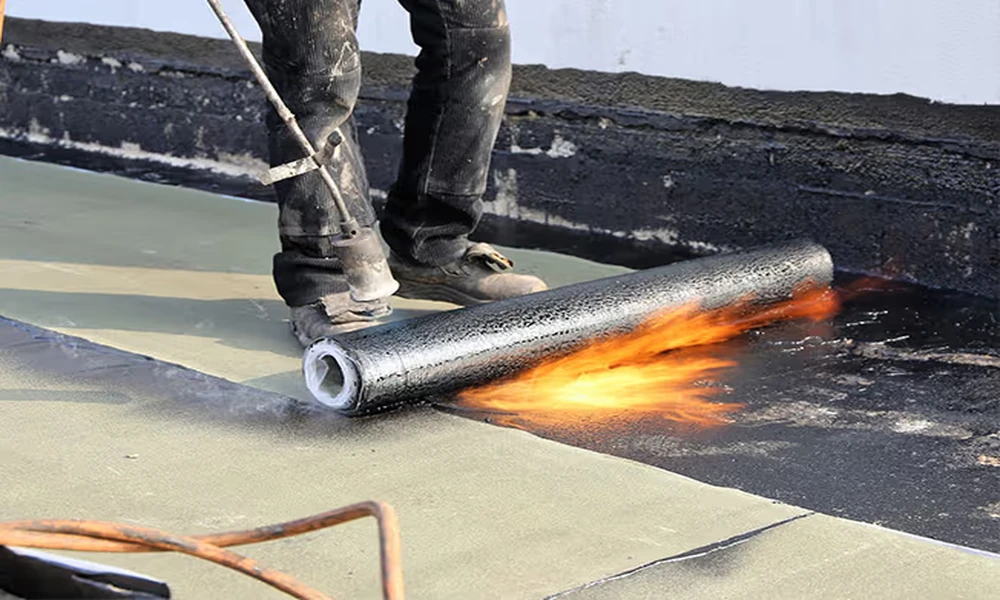
Most people picture a flat roof as a single slab that either leaks or does not. In practice it behaves more like a stack of layers, each with a separate job, and a leak is usually the point where one layer has stopped doing its job and the next was never designed to take over. Following a single raindrop from the sky to the drain outlet is the clearest way to see how torch on membrane waterproofing works, and why it has remained a common choice for flat concrete roofs in a climate that delivers well over two metres of rain a year.
The Raindrop Meets the Cap Sheet
The first surface the water touches is the top of the membrane, usually a cap sheet finished with mineral granules. Those granules are not decoration. They shield the bitumen beneath from ultraviolet radiation, which in Singapore is intense for most of the year and would otherwise dry out and craze an exposed surface within a few seasons. A roof where the granules have washed away in patches is showing early ageing, even if nothing is leaking yet.
What the Bitumen Layer Actually Does
Beneath the granules sits modified bitumen, typically around three to four millimetres thick and reinforced with a polyester or glass fibre mat. The modification, either with APP plastic or SBS rubber, keeps the material flexible enough to follow the slab as it expands in the afternoon heat and contracts in a cool night downpour. The reinforcement gives the sheet tensile strength so it does not tear when the structure shifts slightly.
Why the Torch Matters
The name comes from the installation method. A propane torch softens the underside of each roll until the bitumen becomes molten, and the installer presses it onto the primed slab as the roll is unwound. The result is not a sheet sitting on the roof but a sheet fused to it. Water that finds a small surface defect has nowhere to travel sideways, because there is no air gap between membrane and concrete.
The Primer Underneath
The raindrop never reaches the primer on a sound roof, but the primer decides whether the bond holds for years. A bitumen-based primer soaks into the surface pores of the concrete and leaves a tacky film that the molten membrane can grip. Skipping it, or applying it to a damp or dusty slab, produces a membrane that looks fine on handover day and later lifts in blisters as trapped moisture expands in the sun.
Laps: Where Two Sheets Become One
Rolls are roughly a metre wide, so any roof has many joints. Each sheet overlaps its neighbour, commonly by around 100 millimetres along the sides and more at the ends, and the overlap is torched until a small bead of bitumen squeezes out along the edge. That bead is the visible sign of a proper fusion. When a raindrop runs along a lap, it should find one continuous material rather than a seam. Poorly fused laps are the single most frequent source of early failure in torch on membrane waterproofing.
Upstands, Parapets and Penetrations
Water rarely gets in through the middle of the roof. It gets in where the flat surface meets something vertical: parapet walls, plant plinths, pipe sleeves, and the base of water tanks. Here the membrane must turn upwards, usually by at least 150 millimetres, and be terminated under a flashing or into a chase so that water cannot run behind the top edge. Corners need pre-formed reinforcing pieces because a single folded sheet stretches and thins exactly where it is most stressed.
Falls and Drainage Outlets
A membrane is waterproof, but it is not designed to sit under standing water indefinitely. The slab, or a screed laid over it, should fall gently towards outlets so that the raindrop keeps moving. At each outlet the membrane must be dressed down into the drain body and clamped, otherwise water simply runs under the sheet at the lowest point of the roof, where it does the most damage.
Testing Before the Roof Is Signed Off
On a new installation, the reliable check is a flood test: outlets are temporarily plugged and the roof is held under a shallow depth of water for a day or two while the ceiling below is inspected. If a contractor resists flood testing, that hesitation is itself useful information.
Signs That the System Is Ageing
Over time the raindrop starts to find weaknesses. Look for exposed bitumen where granules have gone, blisters that feel soft underfoot, laps that have opened along their edges, and cracking at the base of upstands. Internal stains often appear some distance from the actual entry point, because water can travel along the slab before it shows. Annual inspections catch these defects while they are still a patch repair rather than a replacement.
Deciding Whether It Suits Your Roof
The system suits accessible flat concrete roofs with moderate foot traffic and plenty of upstands to detail. It is less suited to roofs where open flame poses an unacceptable risk, such as those next to fuel storage or fragile insulation, where cold-applied liquid membranes may be wiser. When comparing proposals, ask about membrane thickness, modification type, lap widths, upstand heights, outlet detailing and whether a flood test is included. A clear specification for torch on membrane waterproofing is the best protection a roof owner can buy.
