

A concrete slab costs $6 to $12 per square foot installed for most residential projects, with a national average around $8. But the per-square-foot number means almost nothing until you know what you’re building. A 100 sqft shed pad runs $600 to $1,500 total. A 400 sqft patio runs $2,400 to $6,000. A two-car driveway runs $4,500 to $10,000. A 1,000 sqft home foundation runs $8,000 to $18,000+. The variance comes from thickness, reinforcement, and site prep — not just square footage.
This guide breaks down what concrete slabs actually cost by project type, why thickness requirements vary so much, and where the real money goes in any concrete quote. If you’re getting bids from contractors and trying to figure out why one is $4,000 and another is $7,500 for the same project, the answers are below.
Concrete vs. cement: a quick clarification
Before going further, a definition that affects everything that follows. Cement is a powdered binding material. Concrete is the finished product made by mixing cement with water, sand, and aggregate (typically gravel). When a contractor quotes “cement slab,” they almost certainly mean concrete slab — the terms get used interchangeably in casual conversation. The pricing in this guide refers to standard residential concrete slabs regardless of which term your contractor uses.
Cost by project type
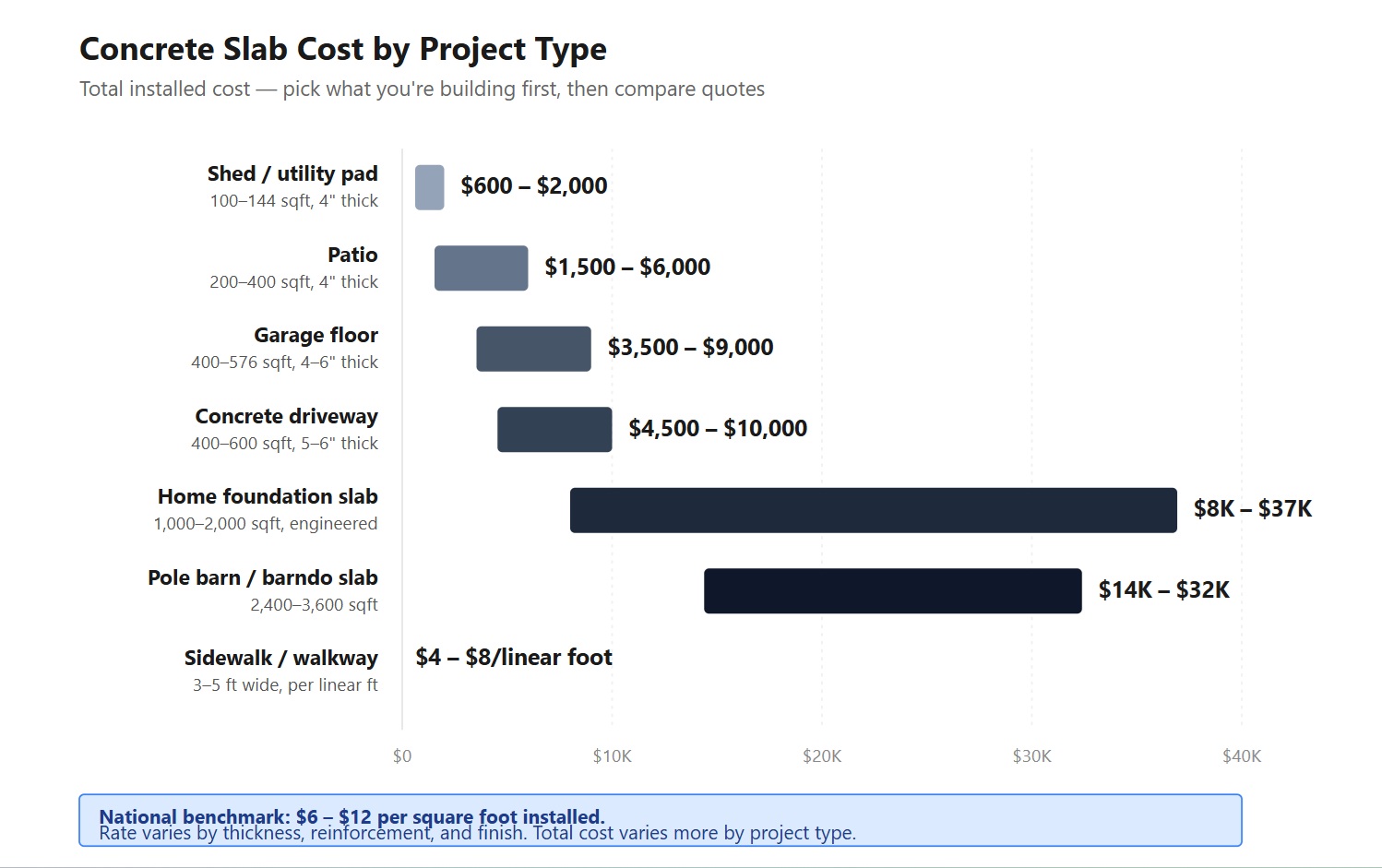
The most useful way to budget a concrete slab is to think about what you’re building, not what the per-square-foot rate is. Each project type has different thickness, reinforcement, and prep requirements that determine total cost.
Shed or utility pad (10×10 to 12×12, roughly 100–144 sqft): $600 to $2,000. Typically 4 inches thick with minimal reinforcement. Subgrade prep is straightforward — clear topsoil, lay gravel base, compact, pour. Most affordable concrete project for a homeowner. DIY-feasible for someone with the right help.
Patio (10×20 to 20×20, roughly 200–400 sqft): $1,500 to $6,000. Standard 4-inch thickness with mesh or fiber reinforcement. Cost varies primarily by finish. A basic broom finish is at the low end; stamped, stained, or exposed-aggregate finishes push toward the high end. Decorative finishes can add $4 to $12 per square foot to the base price.
Concrete driveway (two-car, roughly 400–600 sqft): $4,500 to $10,000. Requires 5–6 inch thickness and rebar reinforcement to handle vehicle weight without cracking. Steeper driveways or those serving heavy vehicles (RVs, large trucks) need 6 inches and stronger reinforcement. Subgrade prep is more involved because vehicle traffic over a poorly prepared base will crack a driveway within years.
Garage floor (20×20 to 24×24, roughly 400–576 sqft): $3,500 to $9,000. Similar specifications to a driveway — 4 to 6 inches with reinforcement, sloped slightly toward the door for drainage. Often includes a thickened edge at the perimeter to support garage walls. May need a vapor barrier underneath in regions with high water tables.
Home foundation slab (1,000 to 2,000 sqft): $8,000 to $36,900. This is where pricing diverges most sharply from $/sqft averages. A 1,000 sqft home slab requires engineered specifications — typically 4 inches thick with #4 rebar grid, vapor barrier, perimeter footings, and post-tensioned cables in some regions. Cost depends heavily on local soil, climate, and whether the slab is monolithic or includes a separate footing pour. Engineering plans alone add $1,500 to $5,000.
Pole barn or barndominium slab (2,400 to 3,600 sqft): $14,400 to $32,400. Large agricultural and barndominium slabs run roughly $4 to $8 per sqft depending on thickness, reinforcement, and finish. The 60×60 (3,600 sqft) sweet spot is widely benchmarked at $14,400 to $28,800 with $21,600 as a typical mid-range number.
Sidewalk or walkway (3 to 5 feet wide): $4 to $8 per linear foot. The thinnest standard residential concrete work. Typically 4 inches thick, sometimes 3 inches for purely decorative paths. Cost is more sensitive to subgrade prep than to material because the volume is small.
The per-square-foot rates in pricing tables are useful as a sanity check, but final cost depends on which of these projects you’re actually building.
Why thickness varies — and why it matters
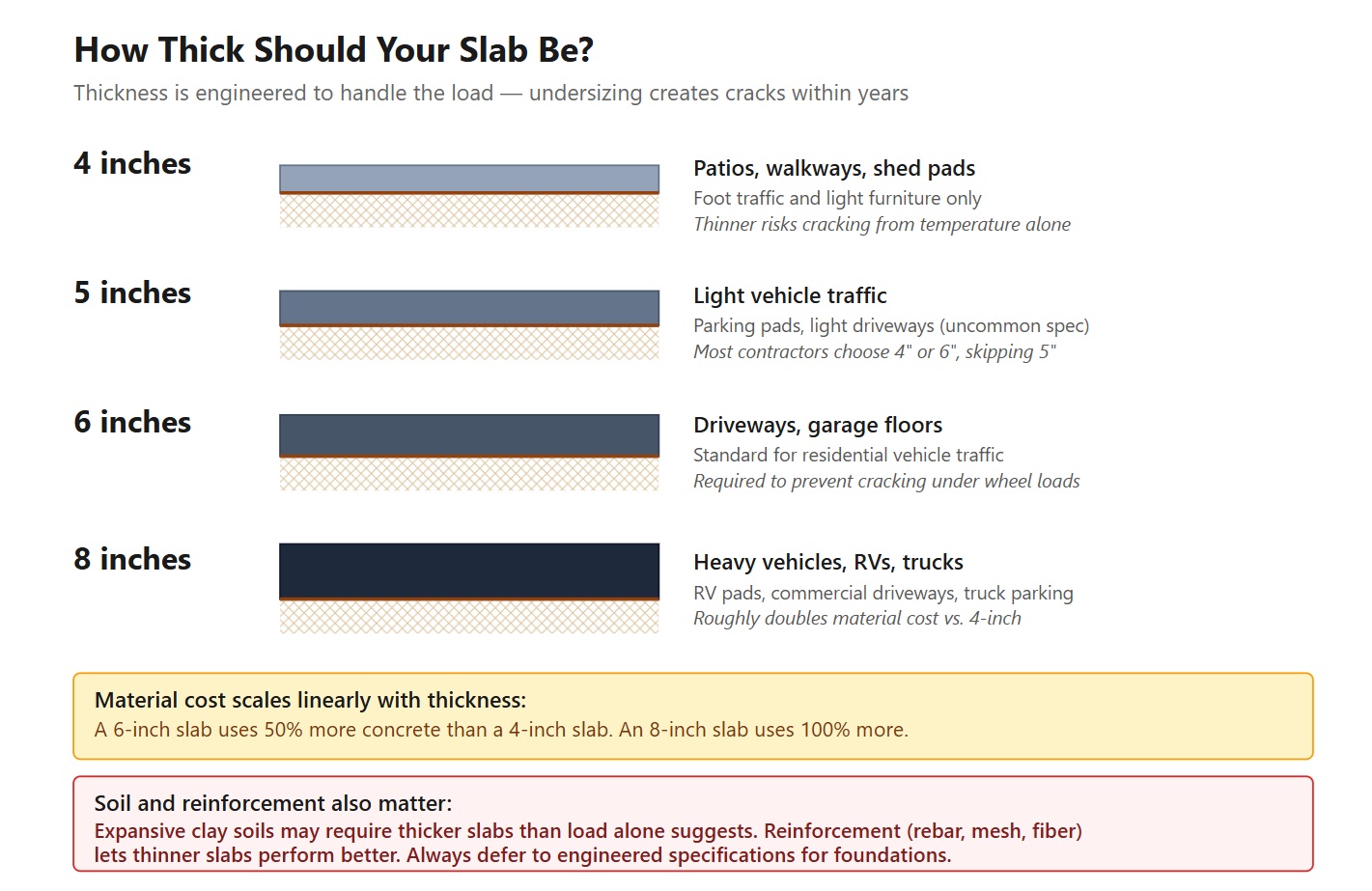
Thickness drives material cost almost linearly — a 6-inch slab uses 50% more concrete than a 4-inch slab of the same area. So why do contractors recommend different thicknesses for different projects? Because the slab is engineered to handle the load it’ll carry over its lifetime.
4 inches: Standard for foot-traffic-only applications — patios, walkways, shed pads, sun decks. Adequate for furniture, grills, and people. Inadequate for vehicles. Thinner than 4 inches risks cracking from temperature changes alone, regardless of load.
5 inches: Light vehicle traffic. Uncommon as a standalone spec; usually a contractor either goes 4-inch or 6-inch. You’ll see 5-inch occasionally for parking pads in low-traffic situations.
6 inches: Standard for driveways, garage floors, and most slabs supporting passenger vehicles. Required to prevent cracking under repeated wheel loads. Most contractors won’t pour a driveway thinner than 6 inches because the warranty exposure is too high.
8 inches: Heavy vehicle traffic — RV pads, commercial driveways, slabs supporting trucks or trailers. Roughly doubles material cost compared to 4-inch. Worth the upgrade if you’ll be regularly parking heavy loads.
10+ inches: Industrial or specialty use. Rare in residential.
Two related decisions interact with thickness. Reinforcement (wire mesh, fiber, rebar) lets a slightly thinner slab perform like a thicker one, which sometimes saves money. Soil conditions can require thicker slabs than the load alone would suggest — soft or expansive clay soils need more concrete to compensate for ground movement, which is why the same garage floor costs different amounts in different regions.
If a contractor proposes a thickness below what the use case calls for, ask why. Sometimes there’s a legitimate reason (very stable soil, limited weight); often it’s a corner being cut.
Where the money actually goes
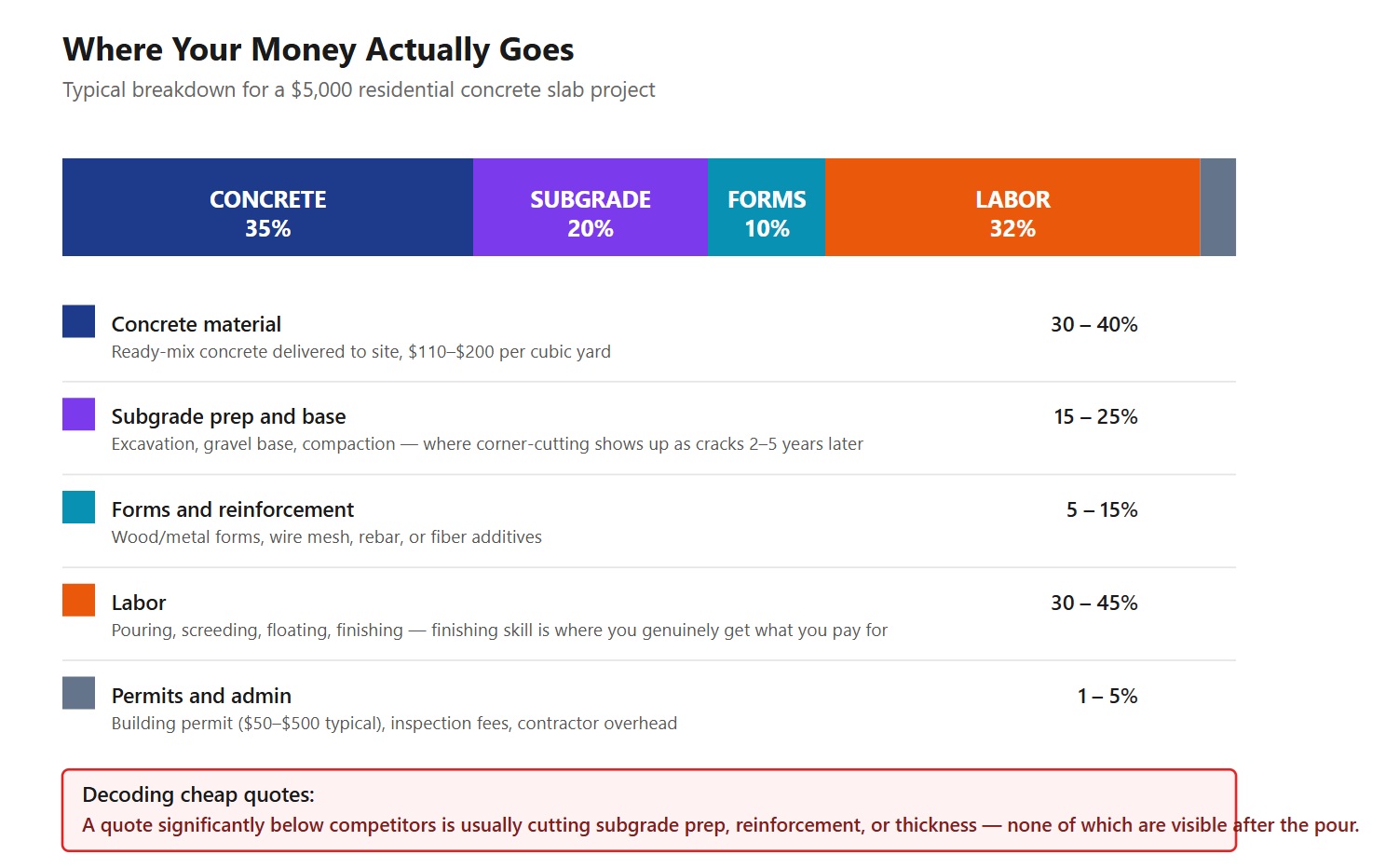
A typical $5,000 concrete slab project breaks down roughly like this. The percentages shift with project size and complexity, but the structure helps you read a quote.
Concrete material: 30 to 40% of total cost. The mix itself, delivered to your site. Priced per cubic yard ($110 to $200 typical, higher in some metros). The ready-mix supplier’s price plus the contractor’s markup.
Subgrade prep and base: 15 to 25%. Excavation if needed, removing topsoil, grading, laying and compacting a gravel or crushed-stone base. This is where contractors most often cut corners on lower bids — a thin or poorly compacted base shows up as cracking 2 to 5 years later.
Forms and reinforcement: 5 to 15%. Wood or metal forms to shape the pour, plus wire mesh, fiber additives, or rebar. A simple rectangular slab uses minimal forms; complex shapes or stepped slabs use more.
Labor: 30 to 45%. Pouring, screeding, floating, finishing. Skilled finishing work is the line item where you genuinely get what you pay for — a poorly finished slab will look bad and may have surface durability issues.
Permits and admin: 1 to 5%. Building permits ($50 to $500 in most jurisdictions), inspection fees, contractor’s overhead.
Finishing/decorative work (if applicable): 0 to 30%. Broom finish is included in standard labor. Smooth troweled, stamped, stained, or polished finishes add cost on top of base — typically $4 to $12 per sqft additional.
A quote that’s significantly cheaper than competing quotes is usually cutting on subgrade prep, reinforcement, or thickness. None of those are visible after the pour.
Cost factors that move your number
Beyond project type and thickness, six factors create most of the variance between quotes.
Site access. Concrete trucks need to get within roughly 20 feet of the pour location with their chute, or the contractor needs to use a pump (adds $500 to $1,500) or wheelbarrow the concrete (adds significant labor cost). Tight urban lots, hillside properties, and homes behind fences or other buildings push costs up.
Soil conditions. Stable, well-draining soil is cheapest. Heavy clay requires deeper excavation and more compaction. Expansive soil (which swells when wet, shrinks when dry) requires engineered solutions to prevent slab movement. Rocky soil increases excavation cost. Wet sites may need drainage solutions before pouring. Site-specific conditions can add $500 to $5,000 to a project.
Demolition and removal. Replacing an existing slab adds $1 to $4 per sqft for breaking up and hauling away the old concrete. Disposal fees vary by region.
Reinforcement type. Fiber additives are cheapest but provide modest crack resistance. Wire mesh adds $0.30 to $0.50 per sqft. Rebar grid adds $1 to $3 per sqft. Post-tensioned cables (used in some home foundations and large slabs) significantly more. The right choice depends on the load and the soil.
Decorative finishes. Standard broom finish is included. Smooth troweled adds $1 to $3 per sqft. Acid-stained adds $2 to $6 per sqft. Stamped adds $8 to $18 per sqft. Polished adds $3 to $12 per sqft. Decorative work also requires more skilled labor and often longer timelines.
Climate and timing. Cold-weather pouring (under 40°F) requires additives, blankets, or heating to cure properly. Hot-weather pouring (over 90°F) requires retarders and careful timing to prevent flash setting. Off-season pours sometimes get discounted rates from contractors with empty schedules; peak-season pours sometimes carry premiums.
Region. Coastal and high-cost metros (West Coast, Northeast, major Texas metros) typically run 20 to 40% above central US pricing. Rural areas can run lower than national averages but may have fewer contractors competing on price. Concrete supply also varies — areas far from a ready-mix plant pay delivery premiums.
DIY vs. professional installation
Concrete is one of the few major construction materials where DIY genuinely makes economic sense for the right project — and is genuinely a bad idea for the wrong one.
DIY-reasonable: Shed pads up to about 12×12, walkways and small paths, simple patios up to about 200 sqft if you have help. The math: a 10×10 shed pad uses about 1.25 cubic yards of ready-mix concrete (delivered cost $200 to $400) plus about $100 to $200 in forms, gravel, mesh, and rental tools. Total DIY cost: $300 to $600 vs. $600 to $2,000 hired out. Real savings.
The skills required: building forms square and level, preparing a properly compacted gravel base, ordering the right amount of concrete, and finishing the surface within the working time window (typically 60 to 90 minutes after pour). The last one is the hardest. A failed finish becomes a permanent eyesore.
DIY-possible but not recommended: Standard patios over 200 sqft, simple parking pads. The volume of concrete becomes harder to manage with two people, and the finishing window doesn’t extend with project size. If you DIY this, plan to hire a finisher specifically for the troweling phase — finishing labor costs less than redoing the whole slab.
Professional-only: Driveways, garage floors, home foundations, anything requiring engineered specifications, anything requiring a permit. The structural and warranty implications of doing these wrong are far larger than the labor savings.
The honest math on hiring vs. DIY: for a 100 sqft project, DIY saves perhaps $500 in labor and runs significant risk if you’ve never poured concrete before. For a 400 sqft patio, DIY might save $1,500 but the risk of a failed finish goes up substantially. For anything larger, hire it out — the savings shrink relative to total cost and the consequences of mistakes don’t.
How to compare contractor quotes
Three quotes, minimum. Here’s how to make them comparable.
Get specifications in writing. Thickness in inches, reinforcement type and spacing, concrete strength (PSI rating — 3,000 PSI is residential standard, 3,500+ for driveways and garages, 4,000+ for some specialty applications), finish type. A “4-inch slab” and a “6-inch slab” at the same price are not the same product.
Verify subgrade prep is included. The cheapest quotes often exclude subgrade work or assume “site is ready,” which it almost never is. Ask each contractor to specify excavation depth, base material, base depth, and compaction method.
Check what’s excluded. Permits, demolition of existing concrete, hauling away old concrete, expansion joints, control joints, sealer, decorative finishes, perimeter footings — any of these can be in or out of a quote.
Confirm credentials. Licensed contractor where required, insurance (general liability and workers’ comp), and references from recent concrete projects specifically. Concrete-finishing skill varies more than most homeowners expect; ask to see photos of recent finished work.
Understand the warranty. Most reputable concrete contractors warranty their work for 1 to 5 years on cracking that exceeds normal hairline patterns. Confirm what’s covered and what’s excluded. Settlement cracks from soil movement are typically excluded; contractor-fault cracks should be covered.
Read the timeline. Concrete pours need to align with weather and curing schedules. A contractor who can pour next week is less booked than one who can’t get to you for six weeks — that may indicate quality of demand for their work, or it may just indicate seasonal scheduling. Ask why one is faster than the other.
Permits, codes, and inspections
Most jurisdictions require permits for any concrete work that’s structural (foundations, retaining walls) or any work that increases impervious surface above a threshold (often 200 sqft). Patios, driveways, and garage slabs frequently require permits; shed pads and walkways often don’t.
Building codes specify minimum thicknesses and reinforcement for structural applications. In most US jurisdictions, the International Residential Code (IRC) governs slab-on-grade construction with chapter 4 covering foundations. Specific requirements vary by climate zone — colder regions require frost-protected foundation depths that warm regions don’t.
If your project requires a permit, the contractor typically pulls it. Verify this; permits pulled in the contractor’s name carry liability with the contractor. Permits in your name leave the liability with you.
Frequently asked questions
How long does concrete take to cure before I can use it?
Concrete reaches roughly 70% strength in 7 days and 99% in 28 days under normal conditions. You can walk on it after 24 to 48 hours. Drive a passenger vehicle on it after 7 days. Park heavy vehicles or put significant load on it after 28 days.
Will my concrete slab crack?
Almost certainly, yes. All concrete cracks. Quality concrete work controls where cracks happen using control joints (intentional weak lines that cracks follow) so the cracks aren’t unsightly or structurally meaningful. Poorly done concrete cracks unpredictably and visibly. The goal isn’t crack-free concrete; it’s controlled cracking.
Do I need rebar in my slab?
For 4-inch residential slabs (patios, shed pads), wire mesh or fiber reinforcement is usually sufficient. For driveways, garage floors, and home foundations, rebar is standard and often required by code.
What’s the difference between fiber and mesh reinforcement?
Fiber is mixed into the concrete at the plant, distributing reinforcement uniformly through the slab. Mesh is laid before the pour and lifted into the concrete during placement. Fiber is easier and cheaper; mesh provides slightly better performance for the same project. For a basic patio, either is fine.
Can I pour concrete in winter?
Yes, but it requires precautions — cold-weather concrete additives, insulating blankets, and sometimes ground heaters. Costs more than warm-weather pouring. If you can wait, spring through fall is easier and cheaper.
How thick should my driveway be?
Standard residential driveways: 5 to 6 inches. Driveways supporting heavy vehicles (RVs, trucks, trailers): 6 to 8 inches. Steep driveways: 6 inches minimum. Anything thinner risks cracking under repeated vehicle loads.
Do I need a permit for a concrete slab?
Depends on jurisdiction and project type. Patios, driveways, and garage slabs typically require permits. Walkways and shed pads typically don’t. Always check with your local building department before starting — unpermitted work can cause problems on resale.
How long does it take to pour a residential slab?
Site prep typically takes 1 to 3 days. The actual pour takes a few hours for most residential projects. Finishing happens the same day as the pour. Total project timeline is usually 3 to 7 days from start to finish, with the slab not at full strength for 28 days after.
Can I pour concrete over old concrete?
Sometimes, but rarely advisable. Concrete bonded to old, deteriorated concrete inherits the problems of the substrate. For most projects, removing the old slab and starting fresh produces better results. Overlay products designed for resurfacing exist but are typically used for cosmetic refresh, not structural improvement.
