

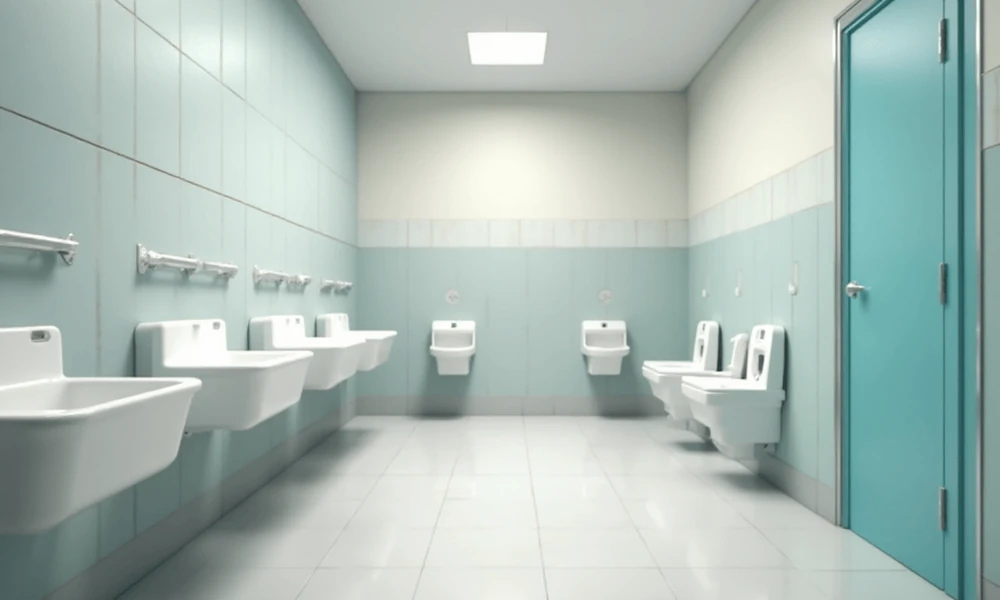
Baby changing stations have moved from optional amenity to expected fixture in public buildings across the United States. Federal law now requires baby changing stations in both men’s and women’s restrooms that are open to the public in federal buildings (BABIES Act). Private-sector owners in retail, hospitality, transportation, and healthcare have followed the same direction, which places new attention on how these fixtures are tested and specified.
Why are changing stations appearing in men’s restrooms?
Changing stations are appearing in men’s restrooms because caregiving roles have shifted. Fathers in the United States reported spending about eight hours a week on childcare in 2016, roughly triple the time reported in 1965 (Pew Research Center). Restrooms that place changing stations only in women’s facilities leave a large share of caregivers without a usable option.
Where do family restrooms fit into this shift?
Family and companion restrooms solve a related problem. A single-user room allows a caregiver to bring a child of any gender, or an adult who needs assistance, into a private space with a changing station, a lavatory, and room to maneuver a stroller. Airports, malls, and stadiums increasingly treat these rooms as a standard part of the restroom core rather than an add-on.
How much load should a changing station support?
Load capacity is the most important structural figure on a changing station submittal. Commercial changing stations are now offered with load testing up to 250 pounds, well above the weight of any infant, to account for foreseeable misuse such as leaning or sitting (American Specialties). That margin matters in public restrooms, where fixtures face use that no manufacturer intends.
What standard governs commercial changing stations?
Commercial changing stations in the United States are evaluated against a consumer safety performance specification written specifically for this product category (ASTM International). The standard addresses structural integrity, restraint systems, and warning labels, giving specifiers a common reference point when comparing products from different manufacturers.
Which installation factors affect long-term performance?
Long-term performance depends as much on installation as on the product itself. Planners should confirm four conditions before a changing station goes on the wall:
- Wall construction and blocking rated for the stated load
- Fastener type matched to the substrate, such as masonry or steel stud
- Open space in front of the unit when the bed is lowered
- Door swing paths that do not strike the open bed
How do materials affect cleaning routines?
Material choice affects how quickly custodial staff can clean and disinfect the bed between uses. Nonporous surfaces, sealed seams, and integrated liner dispensers shorten the cleaning cycle and reduce the chance that a soiled unit stays in service. Units with smooth, rounded edges also leave fewer corners where residue can collect.
Should units be recessed or surface mounted?
The choice depends on corridor width and wall construction. Recessed units project less into the room when closed, which helps in tight restrooms, while surface-mounted units are simpler to add during renovations where opening a wall is impractical.
How does infection control apply to changing surfaces?
Changing surfaces need the same disinfection attention as any other high-touch surface in a restroom. Surface contamination can persist long enough to transfer to the next user when cleaning is skipped (Centers for Disease Control and Prevention). Placing a hand sanitizer or lavatory within easy reach of the changing station helps caregivers clean their hands immediately after use.
What should owners take from the load rating data?
Load ratings are a planning signal, not just a specification line. Owners who pair a well-tested unit with proper wall blocking, smart placement in both men’s and women’s restrooms, and a clear cleaning protocol create a fixture that caregivers trust and maintenance teams can support for years. That combination turns a small fixture into a visible sign that a building was designed with families in mind.
