

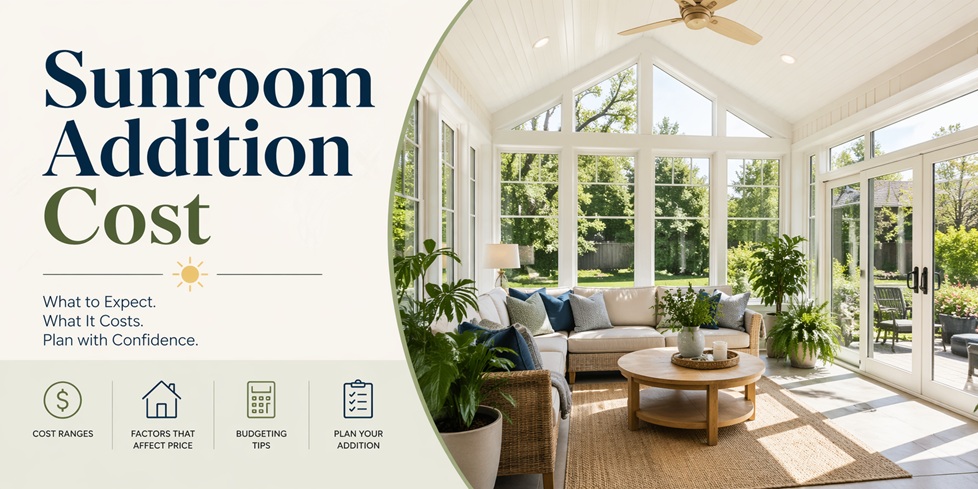
A sunroom addition costs between $11,000 and $160,000, with most homeowners paying $25,000 to $80,000. The range is that wide because “sunroom” covers six genuinely different products — from a $7,000 prefab screen porch to a $180,000 custom four-season conservatory. Your actual cost depends less on square footage and more on which type of sunroom you’re building and whether it’s a seasonal space or a fully insulated year-round addition.
Before comparing any quotes, figure out which of the six sunroom types fits your situation. A contractor quoting $30,000 for a screened room and one quoting $90,000 for a four-season sunroom aren’t competing on the same product — they’re offering different things. This guide breaks down what each type costs, which one actually adds appraised value to your home, and what a complete quote should include so you can compare them line by line.
Six sunroom types, six cost conversations
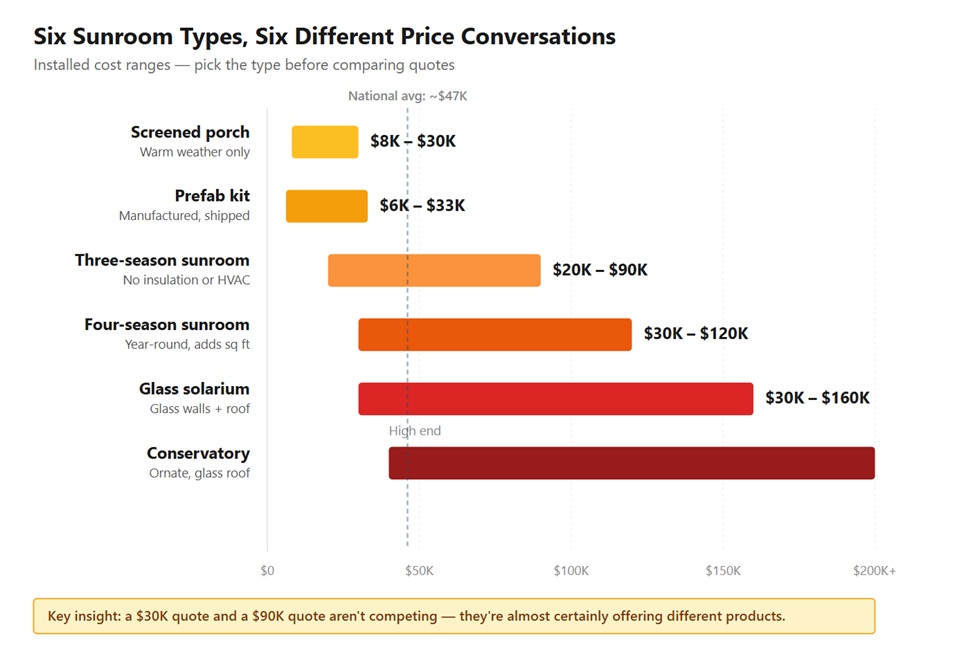
The number you get from a “sunroom cost calculator” means almost nothing until you’ve picked the type. Here’s what each one actually is and what it runs.
Screened-in porch (Arizona room): $8,000 to $30,000. Open-air structure enclosed with screens rather than glass. Insects stay out, weather mostly doesn’t. Usable in warm weather only. The cheapest option because it skips glass, insulation, and climate control. A 200 sqft screened porch built on an existing deck or patio lands around $12,000 to $18,000. This is a porch with mesh, not really a sunroom in the full sense — but it’s what many buyers actually want when they search for one.
Prefab sunroom kit: $6,000 to $33,000. A manufactured sunroom shipped in panels and assembled on a prepared foundation. Aluminum or vinyl framing, single or double-pane glass. Installation by the homeowner or a contractor takes 1–2 weeks. These work as three-season spaces in most climates and aren’t typically designed for four-season use. Quality varies dramatically between manufacturers — the $8,000 kit and the $30,000 kit are not the same product.
Three-season sunroom (custom-built): $20,000 to $90,000. A proper sunroom built on-site with full framing, quality glass, and a permanent roof, but without insulation or HVAC. Comfortable in spring, summer, and fall; too cold in winter and too hot in peak summer without climate control. Most popular option for moderate climates. Does not typically add square footage to an appraisal because it’s not considered finished living space.
Four-season sunroom: $30,000 to $120,000. Fully insulated and integrated with the home’s HVAC system, making it usable year-round. Typically features a knee wall beneath windows rather than floor-to-ceiling glass, to accommodate insulation and electrical. This is the version that adds appraised square footage and the one that delivers the strongest return on investment. The price premium over a three-season room reflects insulation, HVAC extension, code-compliant electrical, and heavier-duty glazing.
Glass solarium: $30,000 to $160,000. More glass than a standard sunroom — typically glass walls plus glass or partially glass roof. More architectural, more structurally complex, more expensive glazing. Often built as a statement space. Can be three-season or four-season; four-season solariums cost significantly more due to the engineering required to insulate a glass roof.
Conservatory: $40,000 to $200,000+. The high end. Full glass roof, ornate framing (Edwardian or Victorian style), often custom architectural detail. More common in luxury builds and historic renovations. Requires specialty glass, specialty framing, and usually a specialty contractor. These are genuine home additions that strongly affect curb appeal and appraisal.
The average sunroom addition costs $40,000 to $55,000 nationally — that number hides enormous variation by type. A meaningful quote starts with picking a type.
Three-season vs. four-season: the decision that drives everything
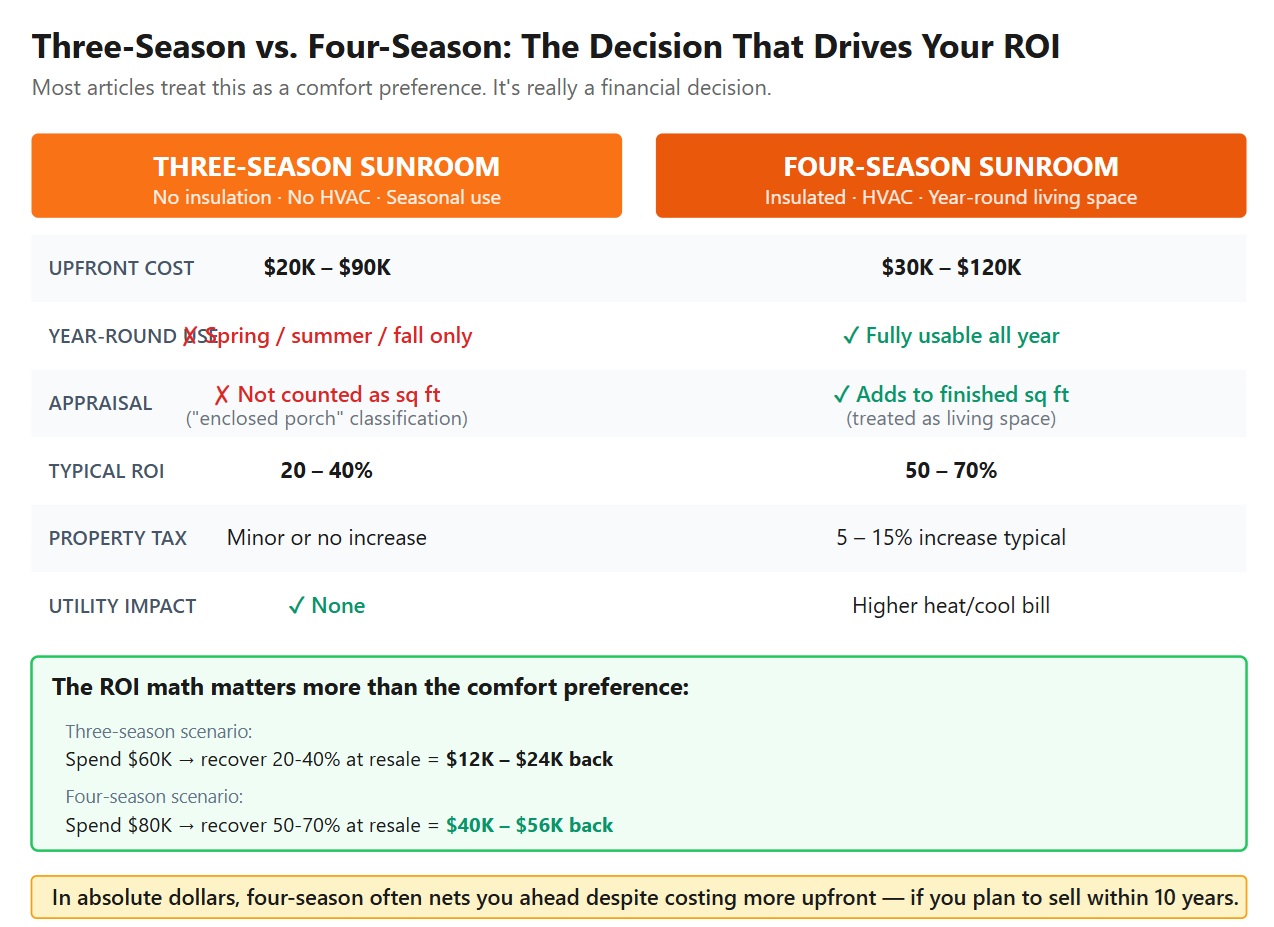
This is the most consequential choice you’ll make, and most cost articles treat it as a comfort preference. It’s not. It’s a financial decision.
Three-season sunroom: No insulation, no HVAC, no heating or cooling. Windows and framing built to keep weather out but not to retain indoor temperature. Typically costs 30–50% less than the same-sized four-season version. Legally and from an appraisal standpoint, a three-season room is usually classified as “enclosed porch” rather than “finished living space.” It does not add to your home’s finished square footage on an appraisal in most jurisdictions.
Four-season sunroom: Full insulation in walls, floor, and (often) ceiling. Connected to your existing HVAC system or has its own. Usable year-round regardless of climate. Classified as finished living space on most appraisals, which means it adds to your home’s square footage and generally 50–70% of its cost to the home’s appraised value.
The financial math matters. If you spend $60,000 on a three-season sunroom, you’ll likely recover 20–40% of that at resale — call it $15,000 to $24,000. If you spend $80,000 on a four-season sunroom, you’ll likely recover 50–70% — roughly $40,000 to $56,000. In absolute dollars, the four-season room often nets you ahead despite costing more upfront.
The case for three-season sunrooms: you primarily want a nice place to sit in warm weather, you’re not planning to sell anytime soon, your climate is genuinely mild, or you already have a covered porch that just needs enclosing. In those situations, spending less up front is the right call and the lower ROI is irrelevant.
The case for four-season: you’re in a cold climate, you want genuine year-round living space, you’re building value into the home for eventual sale, or the price difference is smaller than the HVAC and insulation work implies. If your HVAC already has capacity for an additional 200 sqft, the four-season premium can be surprisingly modest.
One practical caveat: don’t let a contractor talk you into “we can easily add heating later” on a three-season room. It’s rarely true. Insulation and ductwork integrated during construction cost a fraction of what retrofit costs, and retrofit rarely achieves the same thermal performance.
Prefab vs. custom
A separate decision from three-season vs. four-season.
Prefab sunrooms are manufactured kits installed on your prepared foundation. Shorter timeline (1–2 weeks versus 4–8 weeks for custom). Lower cost. Limited customization — you choose from a set of pre-engineered sizes and configurations. The kit itself costs $6,000 to $33,000; total installed cost including foundation, permits, and assembly typically lands $15,000 to $50,000.
Prefab makes sense when: the standard sizes fit your space and vision, you’re working with a constrained budget, you want a predictable timeline, and you accept the aesthetic constraints of mass-manufactured framing.
Custom sunrooms are built on-site from plans drawn for your home. Every dimension, roofline, glazing choice, and finish detail is specified. Much longer timeline. Much higher cost. Significantly better aesthetic integration with your existing home.
Custom makes sense when: your home’s architecture is distinctive enough that a prefab would look out of place, you want specific features (cathedral ceiling, specific window configurations, custom roof tie-in) that prefab doesn’t offer, you’re building a four-season addition that needs to integrate with existing HVAC, or the project budget supports the premium.
The hybrid option most buyers don’t consider: prefab shells finished with custom interior work. You buy a prefab structural kit (saving tens of thousands on framing and glass engineering) and have a contractor handle the foundation, interior finishing, flooring, lighting, and trim. Often the best price-to-quality ratio.
What actually drives price within a type
Once you’ve picked a type, four factors move your number within that type’s range.
Size. Pricing is usually quoted per square foot, but not linearly — very small and very large sunrooms cost more per square foot than mid-sized ones. A 100 sqft sunroom has disproportionate fixed costs (permits, site setup, utility tie-ins). A 400 sqft sunroom requires larger structural members, bigger foundation, and stronger roof framing. The sweet spot for cost per square foot is typically 150–250 sqft.
Foundation requirements. A concrete slab on grade is cheapest ($4–$8 per sqft). A crawl space foundation adds $3,000–$8,000. A full foundation integrated with an existing basement adds $8,000–$20,000. Your existing home’s foundation type often dictates which is required by code.
Glass and glazing. Single-pane glass is cheapest and rarely used in modern sunrooms. Double-pane insulated glass is standard. Triple-pane, low-E, or impact-resistant glass each add 20–50% to window costs. A fully-glazed four-season sunroom can have $15,000–$30,000 in glass alone.
Roof type. A simple shed roof extending from your existing roofline is cheapest. A gable roof that ties into existing framing is moderate. A glass roof (for a solarium or conservatory) is significantly more expensive — often $10,000–$25,000 more than a conventional roof for the same footprint.
Site conditions. Level ground and easy access to the build site are assumed in most quotes. Sloped lots, limited access, mature landscaping that needs protection or removal, utility relocations, and difficult soil conditions all add cost. Ask what the quote assumes about your site.
Existing home specifics. This is the line item most buyers don’t think about. The sunroom has to tie into your existing house — roof integration, siding match, electrical panel capacity, HVAC capacity (for four-season), and foundation compatibility. Older homes with non-standard framing or limited electrical capacity can add $5,000–$15,000 to any quote in unexpected upgrades.
What a complete quote should include
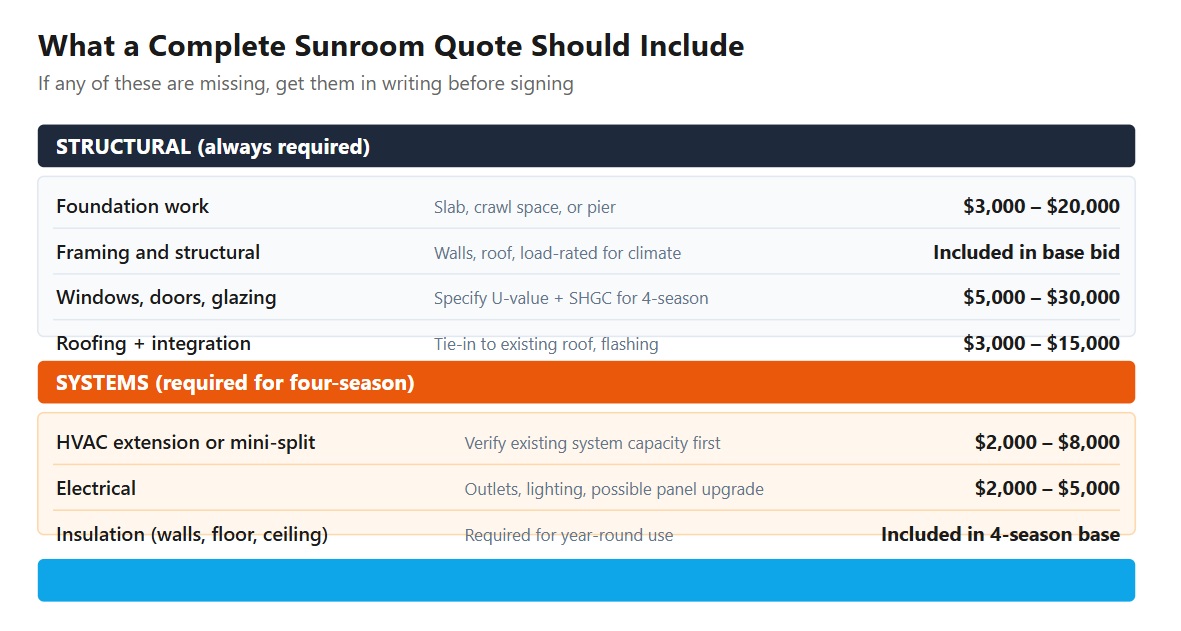
A quote that looks cheap often gets expensive once the missing line items surface mid-project. Before signing, verify the quote specifies each of the following:
Foundation work. Slab pour or crawl space or pier foundation. Excavation, forms, concrete, rebar, finish. For a 200 sqft sunroom, budget $3,000–$8,000 for a slab, more for deeper foundations.
Framing and structural. Wall framing, roof framing, structural members sized for your climate and roof load. For custom sunrooms, engineering stamps may be required depending on jurisdiction.
Windows and doors. Number, size, type, and glazing specification. Entry door(s), window operation (fixed vs. operable), screen specification for operable units. A quality four-season sunroom should specify the U-value and SHGC of the glazing.
Roofing. Roof type, pitch, materials, integration with existing roof, flashing, gutters. Glass roofs require specialty products and installers.
Siding and exterior finish. How the exterior will match (or deliberately contrast with) the existing home. Trim, fascia, soffit, paint, and finish details.
HVAC (for four-season only). Extension of existing ductwork, addition of registers, potential upgrade to existing system if capacity is insufficient. Or installation of a mini-split dedicated to the sunroom. Budget $2,000–$8,000 depending on approach.
Electrical. Outlets, lighting, switches, panel capacity check, possible panel upgrade. Budget $2,000–$5,000 for a typical installation. Panel upgrades run $1,500–$4,000 more if required.
Interior finishing. Flooring, ceiling finish, trim, paint, interior lighting. Often specified as “customer’s choice” with allowances — verify the allowances are realistic for the finishes you want.
Permits and inspections. Building permit ($250–$1,500 depending on jurisdiction), plus any required electrical, plumbing, or mechanical permits. Some contractors include permits in the quote; some pass them through at cost plus a handling fee; some exclude them entirely.
Site prep and cleanup. Tree or landscape removal if needed, debris disposal, final grading, site restoration. Often understated in initial quotes.
If any of these aren’t specified, get them in writing before signing. “We’ll figure that out as we go” is how $50,000 projects become $75,000 projects.
The ROI reality check
Most articles cite a 50% ROI on sunroom additions. That number is approximately right for four-season sunrooms and approximately wrong for everything else. Here’s the honest version.
Four-season sunroom: 50–70% ROI on average. The room counts as finished living space, adds to appraised square footage, and is attractive to buyers in most markets. In cold climates especially, a proper four-season sunroom is a notable selling feature.
Three-season sunroom: 20–40% ROI on average. Buyers value it less than equivalent finished square footage because it isn’t usable year-round. In warmer climates with longer seasons, the ROI approaches the four-season figure; in cold climates, it lags significantly.
Screened porch: 30–50% ROI, but the lower absolute investment makes the ROI percentage less meaningful. A $15,000 screened porch that adds $7,500 to home value still provided years of use — the math works differently than on a $75,000 addition.
Conservatory/solarium: Highly variable. In the right neighborhood and the right home, these are statement features that meaningfully increase value. In the wrong market (a conservatory on a $300,000 tract home), they can overcapitalize the property and actually depress ROI below 30%.
Two honest caveats on all ROI estimates: first, they assume competent construction and quality materials — a poorly built sunroom can actively reduce home value if buyers perceive it as a maintenance liability. Second, these figures are pre-sale. If you plan to stay 15+ years, the ROI question matters less than the cost-per-year of use — a $60,000 sunroom used daily for 15 years costs $11 per day, which for many homeowners is worth it regardless of resale.
Permits, HOAs, and setbacks
Before finalizing any plans, three non-negotiable checks.
Permits. Every jurisdiction requires permits for sunroom additions. Building permits are standard; depending on your project you may also need electrical, mechanical, and plumbing permits. Unpermitted work will cause problems on resale and may not be covered by homeowner’s insurance. Verify your contractor pulls the permits in their name — this ensures they carry the liability.
HOA rules. Homeowners associations often restrict additions, exterior modifications, materials, and even sunroom placement relative to the main structure. Get written HOA approval before starting. HOA rejection after construction is a worst-case scenario you can’t negotiate your way out of cheaply.
Setbacks and zoning. Local zoning rules dictate how close to property lines you can build. Common residential setbacks are 5–15 feet from side property lines and 15–25 feet from rear property lines, but specifics vary widely. A sunroom proposed too close to a property line will require a variance, which is a multi-month process with no guarantee of approval.
Easements and utilities. Utility easements (drainage, sewer, power) on your property can prohibit building in certain areas even if the setback permits it. Have your surveyor or contractor verify there are no easement conflicts before finalizing the sunroom location.
The combined permit, HOA, and survey process typically takes 4–12 weeks. Build this into your timeline.
How to get and compare accurate quotes
Three quotes minimum. Here’s how to make them comparable:
Specify the type clearly upfront. “I want a 200 sqft four-season sunroom” generates comparable quotes. “I want a sunroom” generates incomparable quotes, because each contractor will interpret the scope differently.
Ask for itemized pricing. Using the line items above as a checklist, ask each contractor to price each component separately rather than giving you a single all-in number. This lets you identify where quotes actually differ.
Clarify what’s excluded. Many quotes exclude site prep, permits, interior finishes, or utility upgrades. The cheapest quote with exclusions often becomes the most expensive final bill.
Verify credentials. General liability insurance, workers’ comp, state contractor license (where required), and references from recent sunroom projects specifically. A great deck contractor may not be a great sunroom contractor — the window and roof integration requires different expertise.
Check portfolio. Ask to see photos of completed sunrooms the contractor built, ideally in your neighborhood or of a similar style to what you’re planning. Aesthetic integration with existing homes is where contractor quality shows up.
Get warranty terms in writing. Labor warranty (typically 1–10 years), material warranties (manufacturer-dependent), and what’s excluded. “Lifetime warranty” often has significant exclusions.
Frequently asked questions
How long does a sunroom addition take to build? Prefab kits install in 1–2 weeks. Custom three-season sunrooms typically take 4–8 weeks. Four-season sunrooms with HVAC integration take 6–12 weeks. Timeline extends significantly if structural surprises emerge during construction, which is common with older homes.
Can I build a sunroom myself? Prefab kits are genuinely DIY-possible for experienced homeowners — manufacturers design them for kit assembly. Foundation work, electrical, and roof integration should still be professional unless you have specific trade skills. Full custom sunroom construction is professional-only.
Will a sunroom addition increase my property taxes? Generally yes, and more for four-season than three-season. Four-season sunrooms add to assessed square footage, which increases the tax basis. Three-season sunrooms sometimes do, sometimes don’t, depending on assessor classification. Budget for a 5–15% property tax increase on a four-season addition.
Will a sunroom affect my homeowner’s insurance? Yes. Notify your insurer before or during construction. The addition will need to be added to your policy, which typically increases premiums modestly. Skipping this step can void coverage for claims involving the sunroom.
Do I need an architect? Not typically for prefab sunrooms or standard three-season additions. For custom four-season sunrooms, solariums, or conservatories, architectural plans are usually required by the permit office and genuinely worth the cost ($2,000–$8,000 depending on complexity). Many design-build contractors include architectural services in their quotes.
How close can a sunroom get to my neighbor’s property line? Depends entirely on local zoning. Typical residential setbacks range from 5 to 15 feet from side property lines. Check with your local building department before finalizing plans.
What’s the best season to build a sunroom? Spring and early summer generally, because weather delays are less likely and the finished sunroom is usable for the bulk of the warm season immediately. Late fall and winter construction is cheaper in some markets due to contractor availability but comes with weather risks. Avoid starting exterior work in regions with sustained sub-freezing temperatures.
Can I build a sunroom on my existing deck? Sometimes, but usually not without significant modification. Decks are engineered for live load, not for enclosed structure live load plus dead load plus snow load plus roof load. Most existing decks can’t support a sunroom without reinforcement or full foundation replacement. Have a structural engineer verify before assuming you can skip foundation work.
