

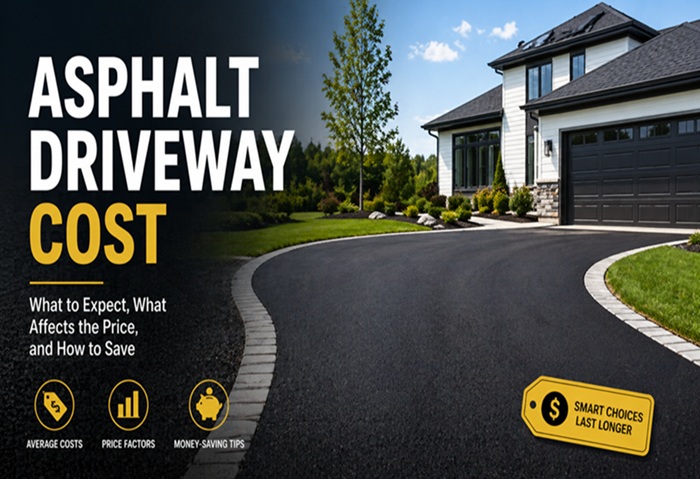
An asphalt driveway costs $7 to $15 per square foot installed, with most homeowners paying $5,000 to $7,500 for a typical residential driveway. The range comes down to which of three jobs you’re actually buying: a new installation on previously unpaved ground ($7 to $13 per square foot), a replacement of an existing driveway ($8 to $15 per square foot, including demolition), or an overlay on a sound existing surface ($3 to $7 per square foot).
Most cost articles lead with size — “200 sqft costs X, 600 sqft costs Y.” The size matters, but the bigger swing in your final price is what’s underneath the asphalt: base depth, base material, soil prep, drainage. A $4,200 driveway and a $7,800 driveway of the same size are different products, and the difference is usually invisible until the cheap one cracks 5 years in. This guide breaks down what each project type actually costs, why base preparation drives long-term value, and when an overlay is a smart fix versus a $4,000 mistake.
Three jobs hiding behind one price range
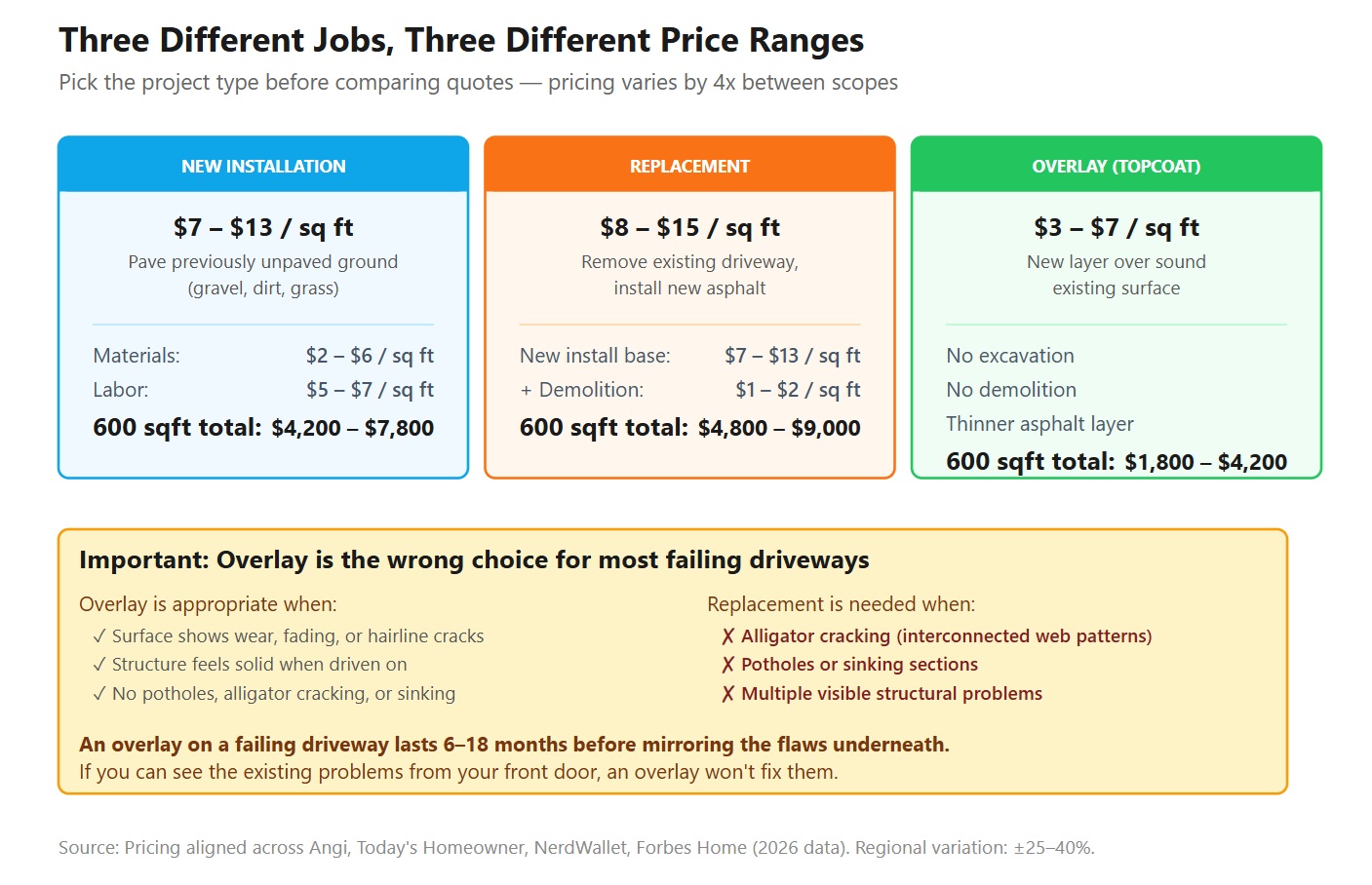
Before comparing any quotes, figure out which of these three projects matches your situation.
New installation: $7 to $13 per square foot
Paving previously unpaved ground — gravel, dirt, or grass. Includes excavation, grading, base preparation, and the asphalt itself. Material costs run $2 to $6 per square foot; labor runs $5 to $7 per square foot. A 600 sqft driveway lands around $4,200 to $7,800.
Replacement: $8 to $15 per square foot
Removing an existing driveway and installing a new one. Adds $1 to $2 per square foot for demolition and disposal of the old surface on top of new-installation costs. A 600 sqft replacement runs $4,800 to $9,000.
Overlay (also called a topcoat or resurface): $3 to $7 per square foot
A thin new layer of asphalt poured over a sound existing driveway. No excavation, no demolition, less material, less labor. A 600 sqft overlay runs $1,800 to $4,200.
The overlay option is where most homeowners go wrong. It’s only legitimate when the existing surface is structurally sound — minor surface wear, fading, small cracks. If the existing driveway has potholes, alligator cracking (interconnected web patterns), or sinking sections, an overlay won’t fix the underlying problems. It’ll look good for 6 to 18 months, then mirror every flaw underneath. Money spent on an overlay over a failing driveway is money lost.
The diagnostic test: if you can see the existing problems from your front door, an overlay isn’t the answer. If the surface is showing wear but the structure feels solid when driven on, an overlay is appropriate.
What’s actually under your driveway matters more than what’s on top
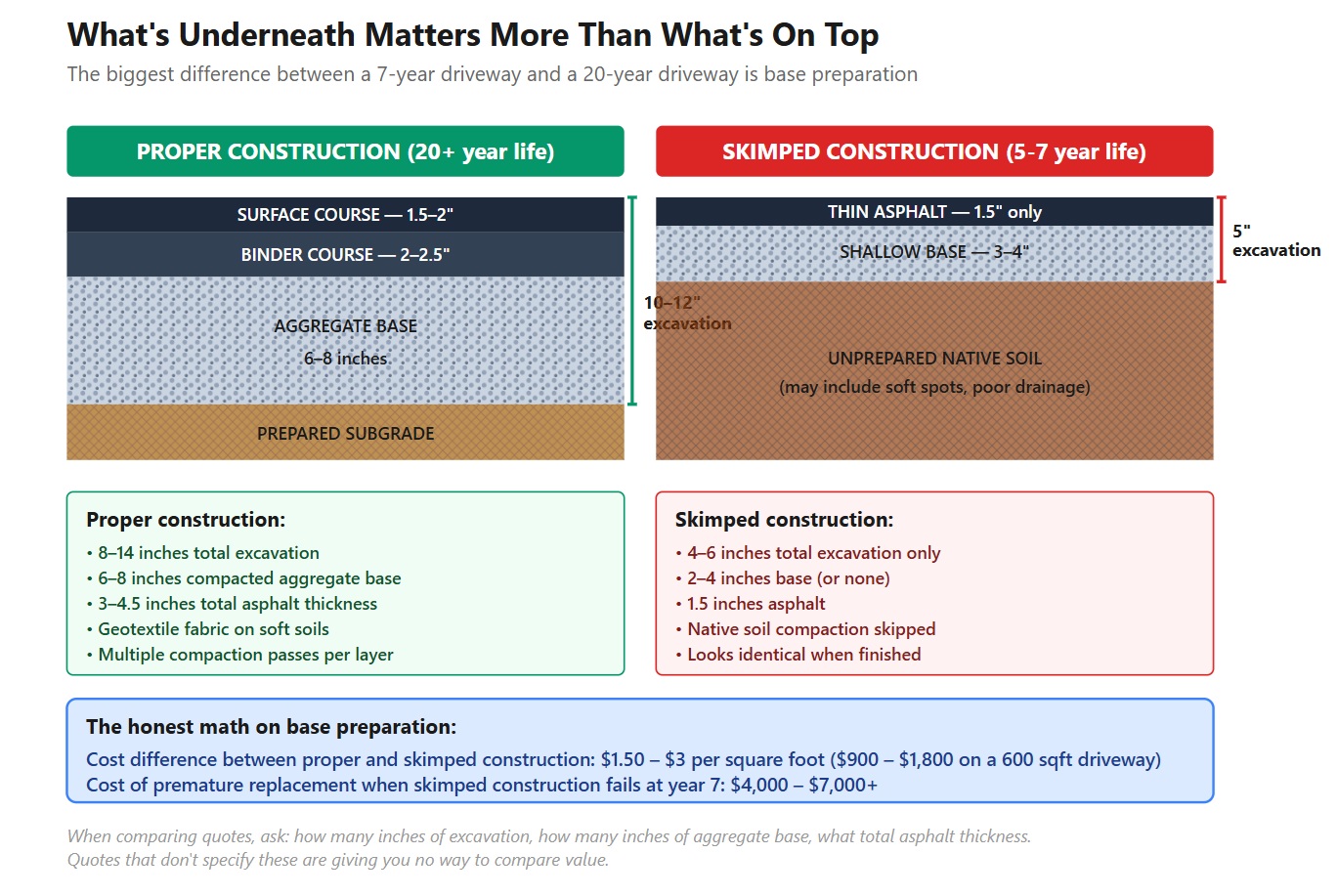
The single biggest variable in long-term driveway cost is base preparation. A properly built asphalt driveway has more material below the surface than visible above it. Skimping here is how budget contractors compete on price — and how driveways crack in 5 to 7 years instead of lasting 20.
A correctly built residential asphalt driveway has these layers, top to bottom:
Asphalt surface course: 1.5 to 2 inches
The visible black layer. Made from hot-mix asphalt — aggregate (small stones) bound with bitumen. This is what gets compacted with rollers during installation.
Asphalt binder course: 2 to 2.5 inches
A coarser, structural asphalt layer beneath the surface course. Some residential driveways use a single 2.5 to 3-inch asphalt layer instead of separate surface and binder courses; either approach works if the total asphalt thickness is adequate.
Aggregate base: 4 to 8 inches
Crushed stone or recycled concrete aggregate, compacted in lifts. This layer carries vehicle load and distributes it to the soil below. Inadequate base depth is the most common cause of driveway failure. 4 inches works for stable soils; 6 to 8 inches is necessary for clay soils or freeze-thaw climates.
Subgrade preparation
The native soil beneath the base, graded for drainage and compacted. Soft or expansive soils may need geotextile fabric and additional excavation. Wet sites may need drainage tile installed before asphalt paving.
Total excavation depth for a properly built driveway: 8 to 14 inches below finished grade. A contractor proposing 4 to 6 inches of excavation total is cutting base depth — the driveway will look fine for the first season and start cracking by year three.
The cost difference between adequate and inadequate base prep is meaningful but not enormous: roughly $1.50 to $3 per square foot. On a 600 sqft driveway, that’s $900 to $1,800. The cost difference between a 7-year driveway and a 20-year driveway is roughly $4,000 to $7,000 in early replacement. Skimping on base prep is the worst dollar-for-dollar trade in driveway construction.
When comparing quotes, ask each contractor specifically: how many inches of excavation, how many inches of aggregate base, what’s the asphalt thickness. Quotes that don’t specify these are giving you no way to compare.
Cost factors that move your number
Beyond project type and base prep, six factors create most of the variance between quotes.
Driveway size
The dominant variable. Most residential driveways fall between 400 and 1,200 square feet. Per-square-foot pricing actually decreases slightly with size because fixed costs (mobilization, equipment setup) get spread across more area.
Asphalt thickness
Standard residential driveways use 2 to 3 inches of total asphalt. Driveways supporting heavy vehicles (RVs, trucks, trailers) need 3 to 4 inches. Each additional inch adds roughly $0.50 to $1 per square foot. Going from a 2-inch to a 3-inch surface on a 600 sqft driveway costs an additional $300 to $600 — usually worth it for the durability gain in any climate with freeze-thaw cycles.
Site conditions
Level ground with stable soil and no obstacles is what every quote assumes. Reality is usually different. Sloped lots, mature trees with roots crossing the driveway, drainage problems, and existing structures that need to be worked around all add cost. A 15% slope can add 20 to 30% to labor cost. Tree root removal can add $500 to $2,000.
Soil type
Sandy and gravelly soils drain well and provide solid base for asphalt. Clay soils retain water, expand and contract with moisture, and require deeper bases or stabilization. Expansive clay (common in Texas, the Southeast, parts of the Midwest) can add $1,000 to $4,000 to a project for additional excavation, geotextile fabric, or soil amendments.
Demolition of existing surface
Removing concrete or old asphalt runs $1 to $4 per square foot depending on what’s there and how thick. A 600 sqft concrete driveway demolition can run $1,500 to $2,500 by itself, before any new paving starts.
Region and season
Northeast and West Coast pricing typically runs 25 to 40% above national averages. Spring and summer pricing carries premium because of contractor demand; fall installations sometimes get small discounts. Winter installation isn’t possible in cold climates — asphalt requires above-freezing temperatures to compact properly.
Asphalt thickness and what each level supports
The asphalt thickness in your quote tells you what the driveway is engineered to handle.
1.5 to 2 inches: Light-duty applications only. Walkways, foot-traffic paths, decorative surfaces. Not adequate for vehicle traffic on its own. Some contractors propose this for budget driveways and it’s the wrong call — the asphalt will crack within 3 to 5 years under normal car loads.
2 to 2.5 inches: Standard for passenger vehicle traffic on stable soils. Adequate for most residential driveways in moderate climates. The minimum acceptable thickness for a new driveway you expect to last.
3 inches: Better for freeze-thaw climates, slight slopes, or heavier-than-average vehicles (SUVs, light trucks). The default thickness recommendation in most northern states. Adds modestly to cost, dramatically to lifespan.
3 to 4 inches: Required for driveways supporting RVs, large trucks, or trailers. Necessary for steep driveways where vehicles brake and accelerate hard. Common spec for rural properties with heavy vehicle traffic.
4+ inches: Commercial, industrial, or specialty applications. Rare in residential.
If a contractor quotes 1.5 inches for a passenger-vehicle driveway, treat it as a warning sign. The savings are small relative to total cost; the durability loss is significant.
Asphalt vs. concrete: the climate-driven decision
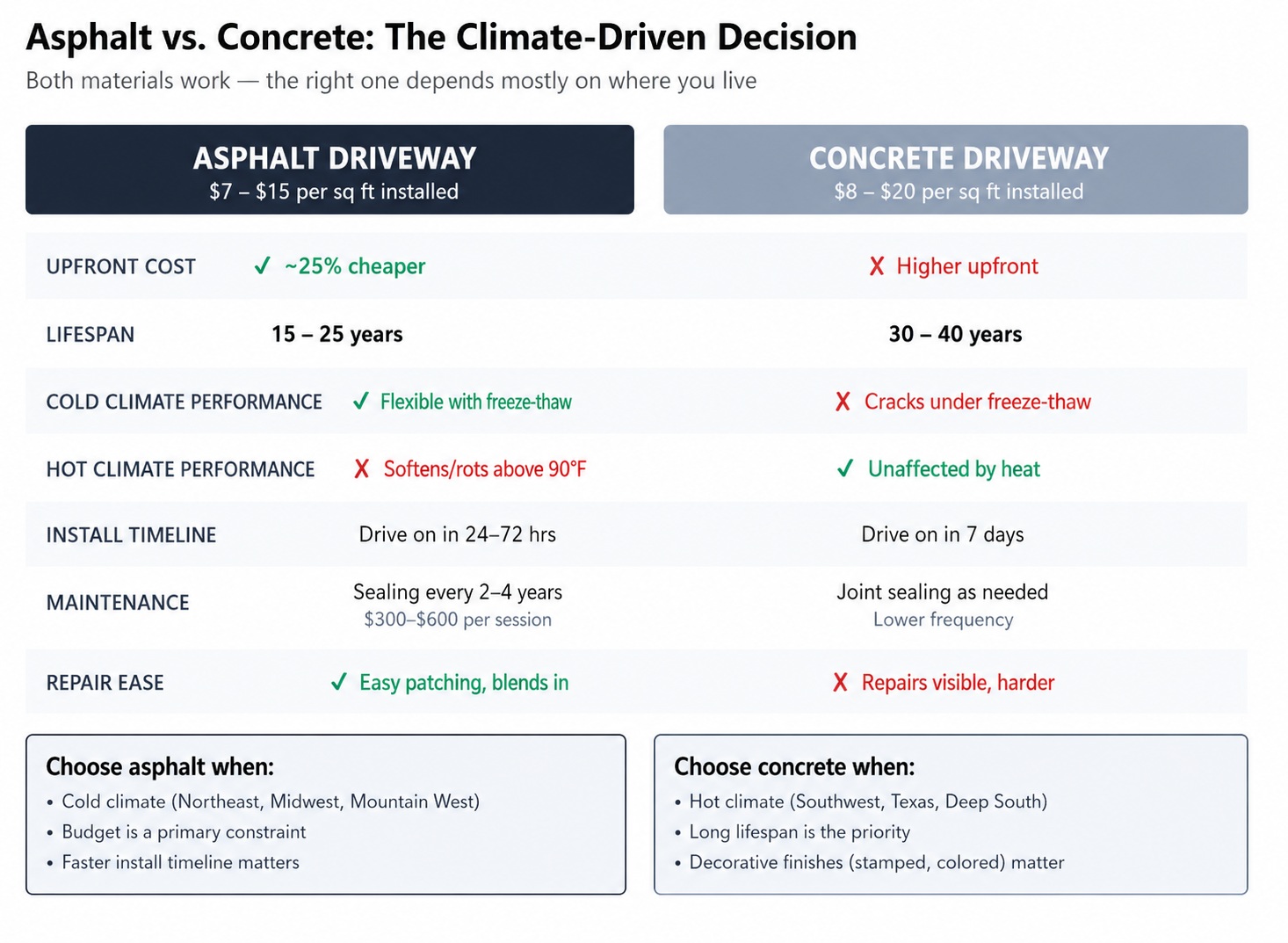
Both materials are popular for good reason, and the right choice depends mostly on climate.
Choose asphalt when:
- You live in a cold climate with regular freeze-thaw cycles. Asphalt flexes with ground movement; concrete cracks under it.
- Budget is a primary constraint. Asphalt installation costs roughly 20 to 30% less than concrete for equivalent driveway size.
- You want a faster install timeline. Asphalt cures in 1 to 3 days; concrete needs 7 to 28 days for full strength.
- Future repairs are a concern. Asphalt is significantly easier and cheaper to patch and repair than concrete.
Choose concrete when:
- You live in a hot climate where summer temperatures regularly exceed 90°F. Heat softens asphalt, causing rutting under vehicle weight; concrete is unaffected.
- Long lifespan is the priority. Concrete lasts 30 to 40 years with maintenance; asphalt lasts 15 to 25.
- You want decorative options. Concrete supports stamped patterns, integral coloring, and exposed-aggregate finishes that asphalt can’t match.
- Higher upfront cost is acceptable in exchange for lower maintenance over time.
The honest summary by region: Asphalt is the dominant choice in the Northeast, Midwest, Mountain West, and the Great Lakes states. Concrete dominates in the Southwest, Texas, and the South. Mixed climates (mid-Atlantic, Pacific Northwest, parts of California) reasonably go either way based on individual preference and contractor availability.
A specific note for borderline climates: if you’re choosing between asphalt and concrete in a place with significant temperature swings between summers and winters, both materials work. Asphalt will need more sealing maintenance; concrete will need control joints managed and may show winter cracking. Neither is wrong.
What a complete quote should include
A quote that looks cheap usually has line items missing. Before signing, verify the quote specifies each of the following.
Excavation depth and method. How many inches of soil/existing material will be removed. Whether tree root removal, stump grinding, or obstacle work is included.
Base material and depth. What aggregate (crushed stone, recycled concrete) and how many inches. Whether geotextile fabric is included for soft soils.
Compaction. Number of passes with the roller, equipment used. Inadequate compaction is invisible but causes early failure.
Asphalt specifications. Total thickness, whether single or two-course (binder + surface), hot-mix or warm-mix, mix design (the formal recipe — Superpave or state DOT spec).
Edge treatment. How the edges are finished — beveled, formed against a curb, etc. Unsupported edges crack first.
Sealing and curing time. When you can drive on it (typically 24 to 72 hours), when initial sealing should happen (usually 6 to 12 months after installation, not immediately).
Warranty terms. Industry standard is 1 year on workmanship; longer warranties exist but read the exclusions. Cracking from soil movement is typically excluded.
Permits. Building or driveway permits run $50 to $500 in most jurisdictions. Confirm whether they’re included or extra.
Disposal of demolished material. Old concrete or asphalt removal typically includes hauling, but verify.
A quote that’s significantly cheaper than competing quotes for the same scope is usually missing one of these or specifying inadequate amounts on excavation, base, or asphalt thickness.
Maintenance: what extends a 15-year driveway to 25 years
Asphalt’s biggest weakness is sun and water. Both can be managed.
Initial sealing: $0.15 to $0.30 per square foot. Recommended 6 to 12 months after installation, after the asphalt has fully cured. Coal tar sealants protect against UV damage and water infiltration. A 600 sqft driveway sealing runs $90 to $180 in materials if DIY, $300 to $600 professionally.
Recurring sealing: every 2 to 4 years. Same materials and cost. Skipping sealing accelerates surface wear; over-sealing (every year) doesn’t add benefit and can cause peeling.
Crack filling: $1 to $3 per linear foot. Hairline cracks fill cheaply. Wider cracks need sealing before they collect water and cause base damage. Spring crack inspection and patching is the highest-leverage maintenance task.
Pothole repair: $2 to $5 per square foot. Small areas of failure get patched with cold-mix asphalt. Larger or deeper failures suggest base problems that require proper repair.
Resurfacing: $3 to $7 per square foot, every 15 to 20 years. Eventually, the surface course wears through and needs replacement even if the base is sound. A scheduled resurface at year 15 to 20 doubles the driveway’s effective life.
Avoid: Heavy point loads (motorcycle kickstands, RV jacks without spreader plates), petroleum spills (gasoline and oil dissolve asphalt binder), and de-icing salt in extreme amounts. These accelerate wear in ways that maintenance can’t reverse.
The math: a 600 sqft driveway that costs $5,000 to install and gets minimal maintenance lasts 15 years — that’s $333 per year. The same driveway with proper maintenance ($300 every 3 years for sealing, $200 every 5 years for crack repair) costs an additional $1,800 to $2,500 over 25 years but lasts 25 years instead of 15 — bringing the per-year cost down to $260 to $300. Maintenance is meaningfully cheaper than premature replacement.
DIY: where it makes sense and where it doesn’t
Asphalt driveway installation is professional-only for almost all situations. The work requires hot-mix asphalt that arrives at the site at 250 to 300°F and must be placed and compacted within roughly an hour. The equipment (paver, roller, transfer trucks) costs more to rent than the project saves. Hot-mix asphalt can’t be bought in small quantities from home centers — you need a contractor who has a relationship with an asphalt plant.
DIY-reasonable: Sealing, crack filling, pothole patching with cold-mix asphalt. These are real maintenance tasks that DIY genuinely saves money on. A weekend with a sealing rig and cold patch product costs $150 to $300 in materials versus $400 to $700 hired out.
DIY-impossible: Initial installation of a hot-mix asphalt driveway. Professional-only.
What you can do yourself to reduce contractor costs: get the site as close to ready as possible (clear vegetation, mark utility locations, ensure access for equipment), choose a fall installation if your climate allows (some contractors discount off-peak), and combine your project with neighbors if possible (mobilization costs spread across multiple driveways drop per-job pricing).
Permits, codes, and HOA considerations
Three checks before finalizing plans.
Local permits. Many municipalities require permits for new driveway installation, especially if the driveway connects to a public road or affects stormwater drainage. Permit fees range from $50 to $500. Replacement of an existing driveway sometimes requires permits, sometimes doesn’t. Check with your local building department.
Stormwater and impervious surface rules. Some jurisdictions limit the percentage of a property’s surface that can be impervious (driveways, patios, structures). Adding or expanding a driveway may require stormwater management features (rain gardens, permeable pavement) if you’re approaching the limit.
HOA restrictions. Homeowners associations often regulate driveway materials, colors, and even paving timing. Verify approval before signing a contract. HOA-mandated changes after construction are expensive and difficult to reverse.
Setbacks from property lines. Driveways generally need to be set back from side property lines by 3 to 5 feet, depending on jurisdiction. Easements (utility, drainage) can prohibit paving in specific areas regardless of setback.
These checks together usually take 2 to 6 weeks. Build that into your timeline if you’re working toward a specific completion date.
Frequently asked questions
How long does an asphalt driveway last?
15 to 25 years with proper maintenance. The lower end is typical for unmaintained driveways in harsh climates; the higher end requires regular sealing, crack filling, and resurfacing at year 15 to 20.
When can I drive on a new asphalt driveway?
24 to 72 hours after installation for passenger vehicles. 7 to 14 days before parking heavy vehicles or putting any point loads on the surface. Asphalt continues to cure for 30 days after installation; treat the first month gently.
Can I install asphalt over an existing concrete driveway?
Yes, but it’s usually not the best long-term solution. Concrete and asphalt expand and contract differently with temperature, which causes cracking in the asphalt overlay over time. The overlay is cheaper than full removal-and-replacement upfront but typically lasts only 7 to 12 years before needing redoing.
What’s the difference between hot-mix and cold-mix asphalt?
Hot-mix asphalt is the standard installation material — produced at a plant at 250 to 300°F and laid down immediately. Cold-mix is a patching product that can be applied at ambient temperature for repairs. Cold-mix isn’t suitable for full driveway installation; it’s pothole repair material.
Should I get my driveway sealed immediately after installation?
No. New asphalt needs 6 to 12 months to cure and release its volatile compounds before sealing. Sealing too early traps these compounds and can cause the asphalt to remain soft. Wait at least 6 months; 9 to 12 months is better in moderate climates.
Does an asphalt driveway add value to my home?
Yes, modestly. A new driveway typically returns 50 to 80% of its cost in added home value. The bigger value is that an old, failing driveway actively reduces home value and curb appeal — replacing one before selling is often worth doing for sale-readiness reasons even if the ROI math is mediocre.
Can I use my driveway for basketball or other activities?
Yes, but be aware that point loads (basketball hoops with concrete bases, heavy equipment) can damage asphalt over time. Use spreader plates under any heavy or pointed equipment. Standard play activity (kids playing, basketball) is fine.
How do I know if my driveway needs replacement vs. an overlay?
Overlay is appropriate if the existing surface has minor cracking, fading, or surface wear but the structure feels solid when driven on. Replacement is necessary if you see alligator cracking (interconnected web patterns), sinking sections, multiple potholes, or visible base failure. When in doubt, ask two contractors and compare their assessments.
