

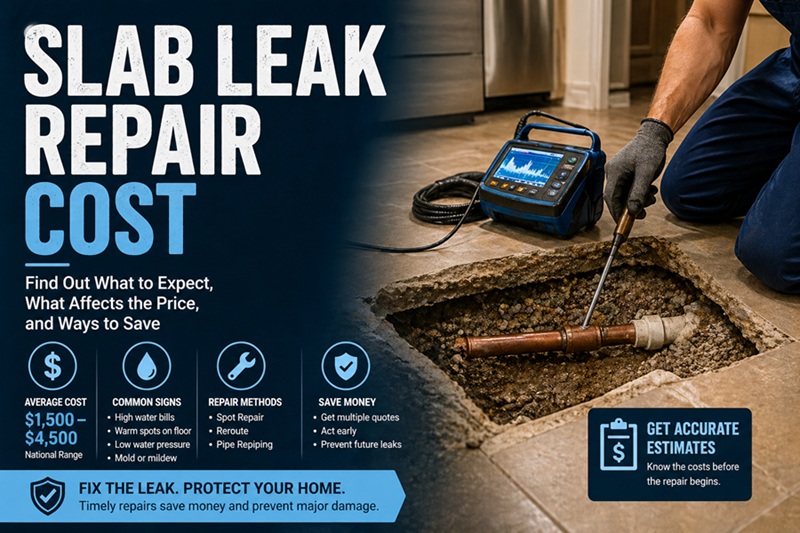
Slab leak repair costs $630 to $4,400 for most homeowners, with a national average around $2,280. Detection alone runs $150 to $600 before any repair starts. The wide range exists because “slab leak repair” covers five genuinely different fixes — from a $500 epoxy patch on a single pinhole to a $15,000 full repipe of all the plumbing under your foundation.
The right repair method matters more than the price, because picking the wrong one wastes money. A spot repair makes sense when the leak is isolated and your pipes are otherwise sound. It’s a poor choice when your home has 40-year-old copper that’s about to spring its second and third leaks. This guide breaks down what each repair method actually costs, when each one is appropriate, and how to think about repair vs. reroute vs. full repipe when a contractor presents you with options.
Five repair methods, five different price points
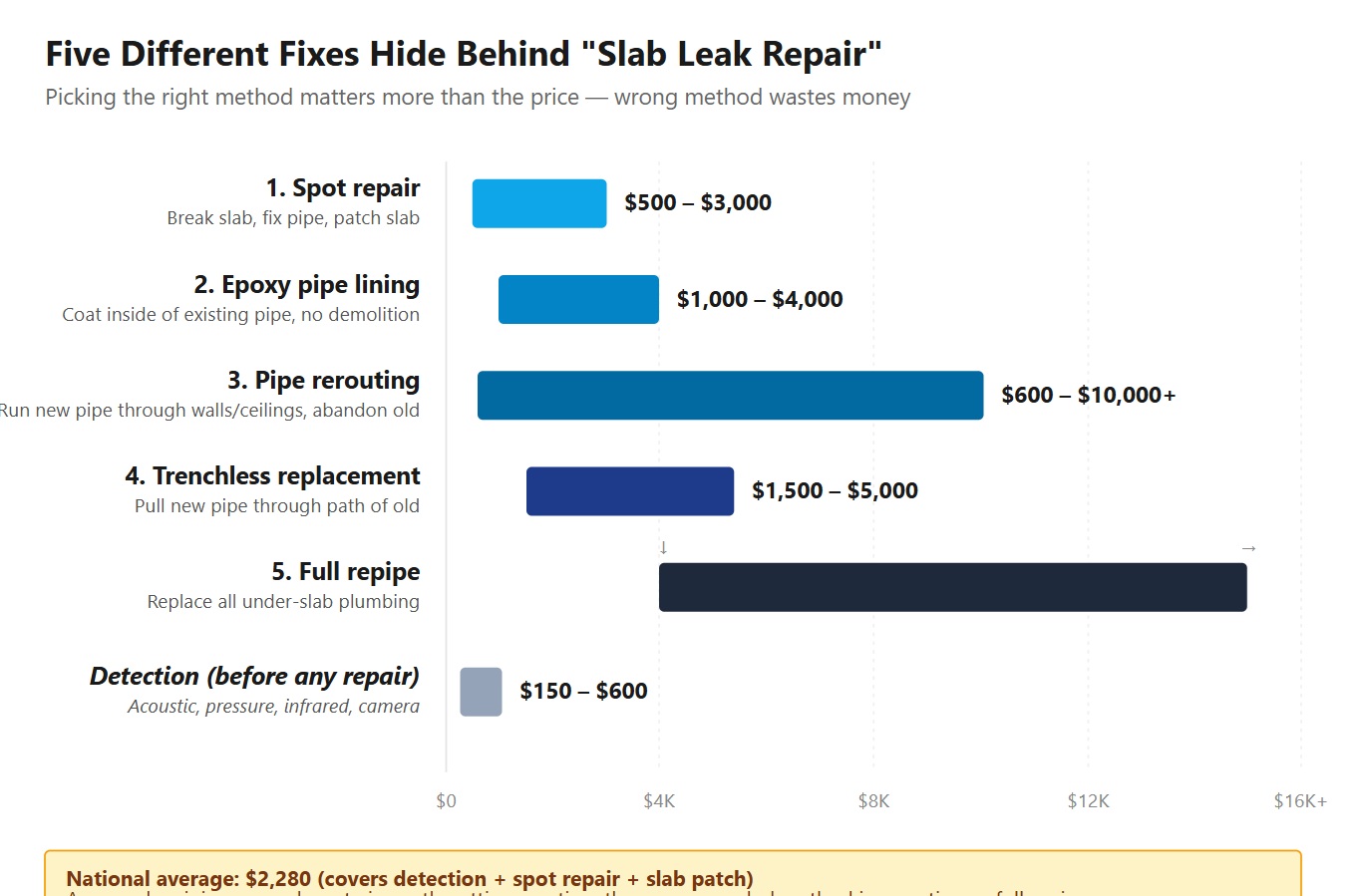
Before comparing any quotes, understand which of these five jobs your situation actually calls for.
Method 1: Spot repair (direct access through the slab) — $500 to $3,000
The plumber jackhammers through the concrete slab to reach the leaking pipe, fixes the leak, then patches the slab and any flooring above. The cheapest option when the leak is accessible (utility area, garage, unfinished basement) and isolated. Becomes expensive when the leak is under finished hardwood, tile, or cabinetry — demolition and restoration of those surfaces can add thousands. Best for: single isolated leaks in newer plumbing systems.
Method 2: Epoxy pipe lining (cured-in-place pipe) — $1,000 to $4,000 typical, $80 to $250 per linear foot.
A liquid epoxy is forced through the existing pipe and cured to form a new pipe inside the old one. No slab demolition required. The leak doesn’t need to be precisely located — the lining seals the entire run. Best for: copper pipes with multiple pinhole leaks, situations where slab demolition would be expensive (finished floors, tile work).
Method 3: Pipe rerouting (above-slab) — $600 to $4,000 typical, $10,000+ for complex jobs
The leaking pipe gets abandoned in place, and a new pipe runs through walls, ceilings, or attic space to reach the same fixtures. Avoids slab demolition entirely. Adds visible plumbing in some configurations or requires drywall work to conceal. Best for: leaks under inaccessible areas (under cabinetry, finished hardwood) where the alternative would mean expensive surface restoration.
Method 4: Trenchless pipe bursting/replacement — $80 to $250 per linear foot
A new pipe is pulled through the path of the old, breaking the old pipe outward as it goes. Requires only access points at each end of the pipe run. More involved than epoxy lining but installs a genuinely new pipe rather than coating the old one. Best for: extensively damaged pipes where lining isn’t sufficient.
Method 5: Full repipe — $4,000 to $15,000+
All under-slab plumbing gets replaced or rerouted. Sometimes done in conjunction with a kitchen or bathroom renovation. The most thorough fix and the most expensive. Best for: homes with 40+ year old copper showing repeated pinhole leaks, homes where multiple slab leaks have occurred over a few years, or homes being prepared for sale where buyers will balk at recurring leaks in disclosure.
A contractor’s recommendation should match your specific situation. A single isolated leak in 15-year-old PEX gets a spot repair. A second pinhole leak in 45-year-old copper deserves a hard conversation about repipe rather than another round of spot patches.
Detection: the cost before the cost
Before any repair happens, the plumber has to find the leak. This is its own line item.
Acoustic detection: $150 to $400.
Specialized listening devices that detect the sound of pressurized water escaping a pipe. The standard first-line tool. Works well when the leak is significant and the home is quiet during testing.
Pressure testing: $100 to $250.
Isolating sections of the plumbing and pressurizing them to confirm where pressure drops. Usually combined with acoustic detection.
Infrared/thermal imaging: $200 to $400.
Detects temperature differences in flooring caused by hot water leaks. Less effective for cold-water leaks. Often used as supplementary detection.
Camera inspection: $200 to $600.
Pushing a video camera through the pipe to visually identify damage. More common for drain lines than pressurized supply lines, but used in some slab leak diagnostics.
Tracer gas detection: $300 to $700.
Hydrogen gas pumped through the pipe escapes through the leak point and is detected by sensitive gas sensors above the slab. Most precise method, used when other techniques can’t pinpoint the leak.
A reasonable detection budget is $250 to $500 for a typical residential slab leak. If a contractor quotes detection at the high end, ask what method they’re using and why simpler approaches won’t work first. Detection costs are often credited toward the repair if the same company does both.
One thing worth knowing: a contractor offering “free leak detection” usually rolls the cost into the repair quote. The detection isn’t actually free — it’s bundled. Compare total project quotes, not detection-line-item quotes.
How to tell what’s happening before the plumber arrives
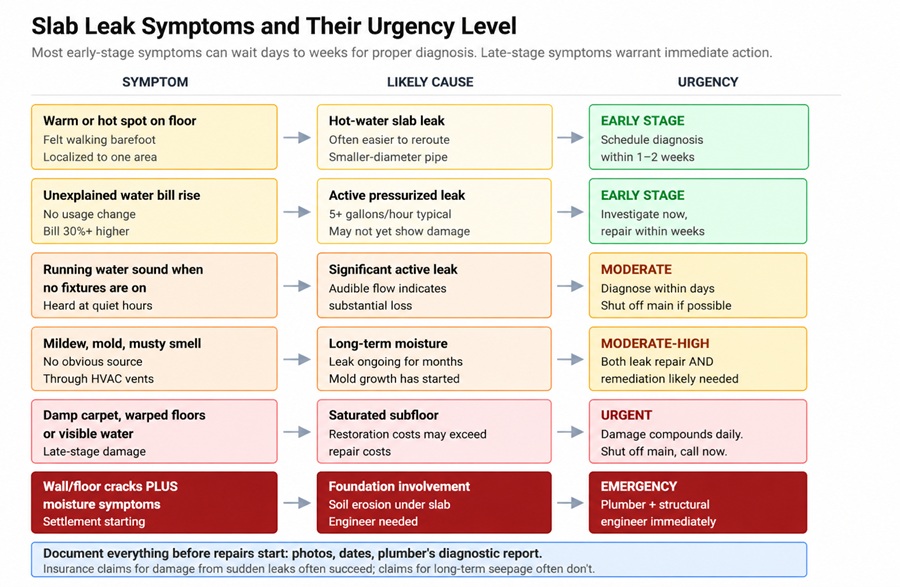
Slab leaks have distinctive symptoms that help narrow down whether you’re dealing with one and how urgent it is.
Warm or hot spot on the floor.
Almost always indicates a hot-water slab leak. Hot-water leaks are easier to detect (noticeable temperature change) and often easier to reroute (smaller-diameter pipes, shorter runs). Cost range typical: $500 to $3,500 for spot repair or reroute.
Unexplained increase in water bill.
Often the first sign before any visible damage. A leak that doubles your water bill is significant — typically 5+ gallons per hour. Worth investigating immediately even if you can’t see anything yet.
Sound of running water when no water is being used.
Indicates active flow somewhere in the system. Turn off all fixtures, listen at quiet hours. Persistent sound means a leak somewhere in the pressurized system, often a slab leak if you’ve ruled out toilets and outdoor connections.
Mildew, mold, or musty smell with no obvious source.
Long-term slab leaks create moisture under flooring that grows mold before any visible damage. The smell often comes through HVAC vents that share return air with affected rooms.
Cracks in walls or floor that weren’t there before.
Slab leaks can erode soil under the foundation, leading to settlement and structural cracking. If you’re seeing both moisture symptoms and structural symptoms, the situation is more urgent and may involve foundation work alongside leak repair.
Damp carpet, warped flooring, or visible water on the floor.
Late-stage symptoms. The leak has been ongoing long enough to saturate flooring. At this point, restoration costs (carpet, flooring, drywall, mold remediation) often exceed the leak repair itself.
No symptoms but routine inspection found dampness under the slab.
Sometimes a leak is detected during real estate inspection or other unrelated work. Less urgent than active visible damage, but should still be addressed within weeks rather than months.
The honest urgency framework: any of the late-stage symptoms (visible water, warped flooring, structural cracking) means the leak has been ongoing and continued damage is happening every day. These warrant emergency or near-emergency attention. Early-stage symptoms (warm spot, water bill increase) can usually wait days to weeks for proper diagnosis without significant additional damage. Don’t ignore them, but you don’t need to panic.
Spot repair vs. reroute vs. full repipe: how to decide
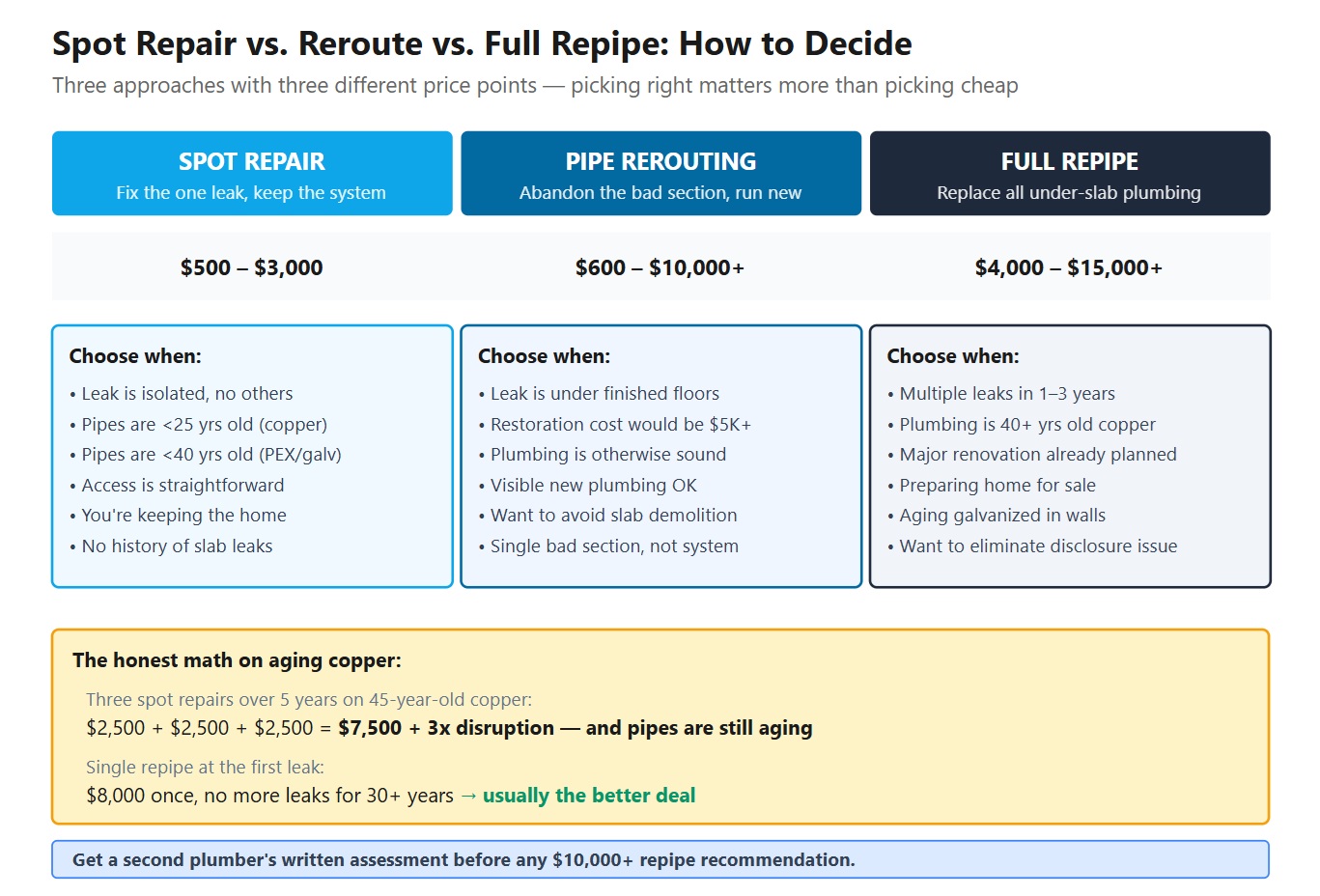
A contractor will often present multiple options with different price points. Here’s how to think through which is right.
Spot repair makes sense when:
- The leak is isolated and there’s no history of other slab leaks
- Pipes are relatively new (less than 25 years for copper, less than 40 for PEX or galvanized)
- Access doesn’t require destroying expensive finished surfaces
- The home is being kept rather than prepared for sale
Pipe rerouting makes sense when:
- The leak is under finished flooring, cabinets, or other surfaces that would cost $5,000+ to restore
- The plumbing is otherwise sound (just one bad section)
- Visible new plumbing or drywall patching is acceptable
- You want to avoid slab demolition entirely
Epoxy lining makes sense when:
- Multiple pinhole leaks have occurred or are likely (older copper)
- The pipe path is accessible for the lining process
- Slab demolition would be very expensive
- You want a longer-term fix without full repipe cost
Full repipe makes sense when:
- The home has had multiple slab leaks in 1-3 years
- Plumbing is 40+ years old copper or galvanized
- You’re already doing major renovation work that opens walls and floors
- You’re preparing the home for sale and want to eliminate the disclosure issue
The honest math on repair vs. repipe: a $2,500 spot repair on a 45-year-old copper system that’s already had one leak is statistically likely to be followed by another spot repair within a few years, then another. By the time you’ve done three spot repairs ($7,500 plus disruption), you’ve spent more than a full repipe and still have aging pipes. If your plumber is recommending a full repipe and your pipes are aged, it’s worth a serious second opinion before defaulting to spot repair.
What’s actually in a complete quote
Beyond the repair work itself, six line items appear (or should appear) on a complete quote.
Detection — $150 to $600. Discussed above. Should be itemized separately.
Permit — $150 to $300. Required in most jurisdictions for any work that breaks the slab. Sometimes included in contractor’s quote.
Demolition (if applicable) — varies. Slab demolition runs $1 to $4 per square foot for typical residential concrete. Cutting through tile, hardwood, or carpet adds $2 to $8 per square foot for surface materials.
The repair itself — varies by method. $500 to $4,000+ as discussed.
Slab patch and surface restoration — $500 to $3,000+. Re-pouring concrete after demolition. Replacing tile, hardwood, or carpet on top. Often a separate trade than the plumber, with its own line item or referred to a separate contractor.
Mold/water damage remediation (if needed) — $500 to $5,000+. If the leak has been ongoing, water damage to subfloor, drywall, or framing may need professional remediation. This often costs more than the leak repair itself when leaks have gone undetected for months.
A complete quote that’s significantly cheaper than competing quotes is usually missing one or more of these. The most common omission is restoration — some plumbers fix the leak and patch the slab, but leave you to handle flooring restoration with another contractor. That can be a $2,000 to $5,000 surprise.
What drives price beyond the repair method
Five factors create most variance within each repair method.
Slab thickness
Residential slabs are typically 4 to 6 inches but can be thicker in some homes. Thicker slabs require more demolition time. Post-tensioned slabs (used in some 1980s+ construction, especially in expansive-soil regions) require specialized work to avoid damaging the tension cables — adds $500 to $2,000.
What’s on top of the slab
Bare concrete in a garage is the cheapest scenario. Carpet over slab adds modest restoration cost. Tile over slab adds significant cost — tile breaks during demolition and matching replacement tile is rarely possible. Hardwood over slab is the most expensive — hardwood removal, slab access, and matching hardwood reinstallation is a multi-trade project.
Pipe material
Copper pipe is more expensive to repair than PEX or PVC because it requires soldering and skilled labor. Modern PEX repairs are faster and cheaper. Galvanized steel (in homes built before 1970) is the most expensive material to work with and typically argues for repipe rather than repair.
Number of leaks
A single isolated leak is straightforward. Multiple simultaneous leaks (sometimes detected during the diagnosis of one) push toward repipe rather than multiple spot repairs.
Region
California, Texas, the Southwest, and Florida have higher slab leak prevalence due to expansive soils, seismic activity, and slab-heavy construction. Pricing in these regions runs 25 to 50% above national averages. The Northeast and Midwest see fewer slab leaks because basement-with-crawl-space construction is more common.
Insurance: what’s actually covered
This is genuinely confusing and most articles oversimplify it. Here’s the honest version.
Most homeowner’s insurance policies cover sudden, accidental water damage from a slab leak.
That includes flooring damage, drywall damage, and personal property damage caused by water from a leak. The damage triggered by the leak is typically a covered peril.
The leak repair itself is usually not covered.
Insurance covers the damage caused by the leak, not the cost to fix the failed pipe. Plumbing repair is considered maintenance.
Long-term slow leaks are typically excluded.
If the insurance company can argue the leak was ongoing for months or years (mold growth, gradual structural damage), they may deny coverage on grounds of “long-term seepage” exclusion. This is a common dispute area.
Foundation damage from slab leaks may or may not be covered.
Depends entirely on policy specifics. Some policies cover foundation damage if it’s caused by a covered peril; some specifically exclude foundation movement from any cause.
Concrete repair to access the pipe is typically not covered.
The slab cutting and patching is part of the repair, not the damage.
What this means practically: file an insurance claim for any slab leak, document everything (photos before any work, the plumber’s diagnostic report, a timeline of when symptoms appeared), and don’t assume coverage either way until your insurer issues a written determination. Some claims that look obviously covered get denied; some that seem unlikely to be covered get approved.
If you have an active leak and aren’t sure about coverage, document and file before starting repairs. Insurance companies typically can’t deny a claim for damage that occurred before they were notified, but they can deny coverage for repairs you authorized without their approval.
Frequently asked questions
How long does slab leak repair take?
Spot repairs typically take 1 to 3 days from arrival to slab patched. Epoxy lining can be completed in a single day for most residential applications. Pipe rerouting takes 2 to 5 days depending on accessibility. Full repipe takes 1 to 2 weeks. Add restoration time after the plumbing work — flooring restoration often takes another 2 to 5 days.
Can I keep using the home during slab leak repair?
Usually yes, with limitations. Spot repair makes one room or area unusable during the work. Pipe rerouting may shut off water to the affected fixtures temporarily. Full repipe typically shuts off water to the home for portions of the project. Plan for possibly 1 to 3 days without water if you’re doing significant repipe work.
What causes slab leaks?
Three main causes: copper pipe corrosion (chemical reaction with concrete or soil over decades), high water pressure (above 80 PSI puts repeated stress on pipes), and ground movement (expansive soils, seismic activity, settlement). Older homes with original copper and homes in expansive-soil regions are most prone.
Can I prevent slab leaks?
Partially. Maintaining water pressure under 80 PSI (with a pressure-reducing valve if needed), watching for early symptoms, and treating any pinhole leak as a warning of potential others can reduce the chance of major problems. Once copper pipes are 40+ years old, prevention is essentially preparing for repipe rather than avoiding leaks entirely.
Should I get a second opinion if a contractor recommends repipe?
Yes, especially if the recommendation comes after a single leak. Some contractors push repipe as a default upsell. A genuine recommendation for repipe is supported by evidence — multiple symptoms, pipe age, history of leaks, water quality issues. Get a second plumber’s assessment with a written report before committing to a $10,000+ project.
How long do epoxy-lined pipes last?
Manufacturers typically warranty epoxy lining for 50 years. Real-world performance is shorter where water chemistry is harsh — some installations have failed within 10 to 15 years. The technology is sound but not infallible. Lining buys decades of life in most cases, not a permanent fix.
Are slab leaks dangerous to my health?
The leak itself isn’t dangerous, but secondary mold growth from prolonged moisture can be. If you’ve had a slab leak for an extended period and there’s musty smell or visible mold, professional remediation is recommended before reoccupying affected areas.
What’s the difference between a slab leak and a foundation leak?
A slab leak is in the plumbing pipes under your foundation. A foundation leak is water seeping in through cracks or porous concrete in the foundation itself. Slab leaks come from inside the plumbing system; foundation leaks come from groundwater outside. Different problems with different fixes.
Can a DIY slab leak repair work?
No, in nearly all cases. Slab leak repair requires specialized detection equipment, slab demolition, plumbing skill, and code-compliant restoration. Even experienced DIYers should not attempt this work — the consequences of a botched repair (recurring leaks, code violations, denied insurance claims) far exceed the labor savings.
